














A recently published patent application shows how Aprilia planned to shake up MotoGP aerodynamics before being hampered by a rule change in 2020 – but the idea could still be adapted on a hyper sports car.
The patent focuses on one of the most persistent problems with hyper sports cars: getting enough air to the radiators without creating more drag than necessary.
The traditional position of a motorcycle's radiator, between the engine and the front wheel, is a major compromise when it comes to aerodynamics. The mass of the radiator and the water inside it mean it's useful to place it here rather than, say, under the saddle (like Benelli), and it's also exposed to significant air flow in this position. However, the airflow reaching the radiator is inevitably disrupted by the front wheel, meaning the radiator has to be larger than it needs to be. This, in turn, results in a weight penalty.
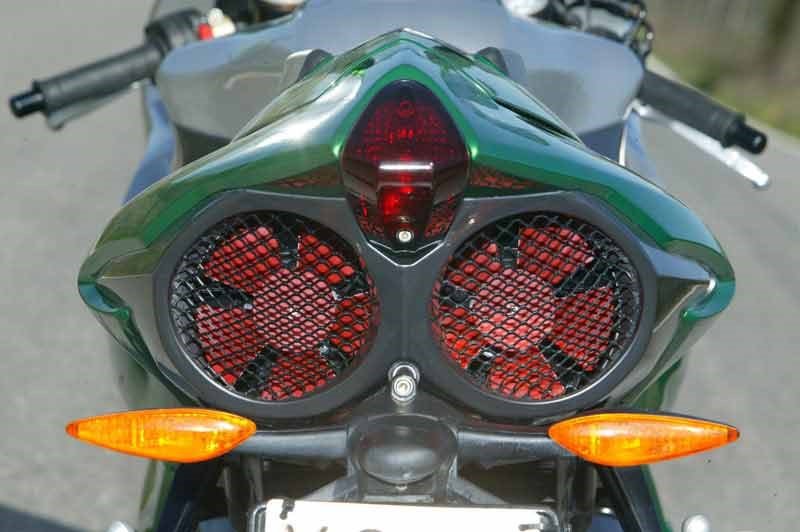
Benelli hot air extraction system
On certain sports cars, engineers have looked for alternative solutions, such as the radiator placed under the saddle – with two hot air extractors – in the case of the Benelli Tornado 1130.
Another different case is that of the Honda VTR 1000 saga, which had in the case of the F model but also the SP1 and SP2 a radiator on each side of the fairing.
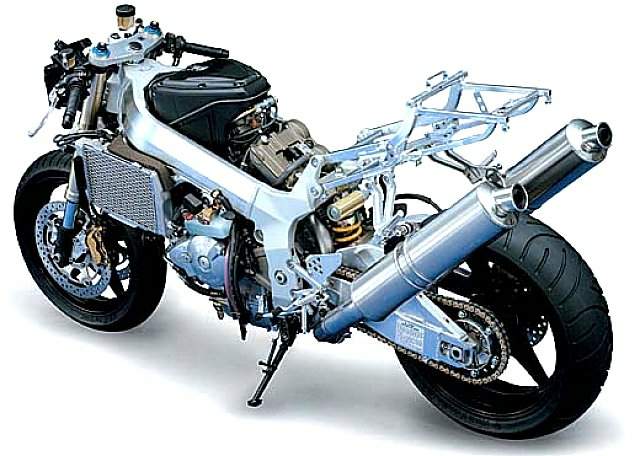
The Honda VTR1000SP2 and its two side radiators
Regardless, hyper sports cars today continue to mount a large radiator at the front and on competition bikes, where every detail counts, this is not a minor problem.
The Aprilia system
The BikeSocial website has discovered sketches of an Aprilia cooling system that appeared intended for their MotoGP prototype.
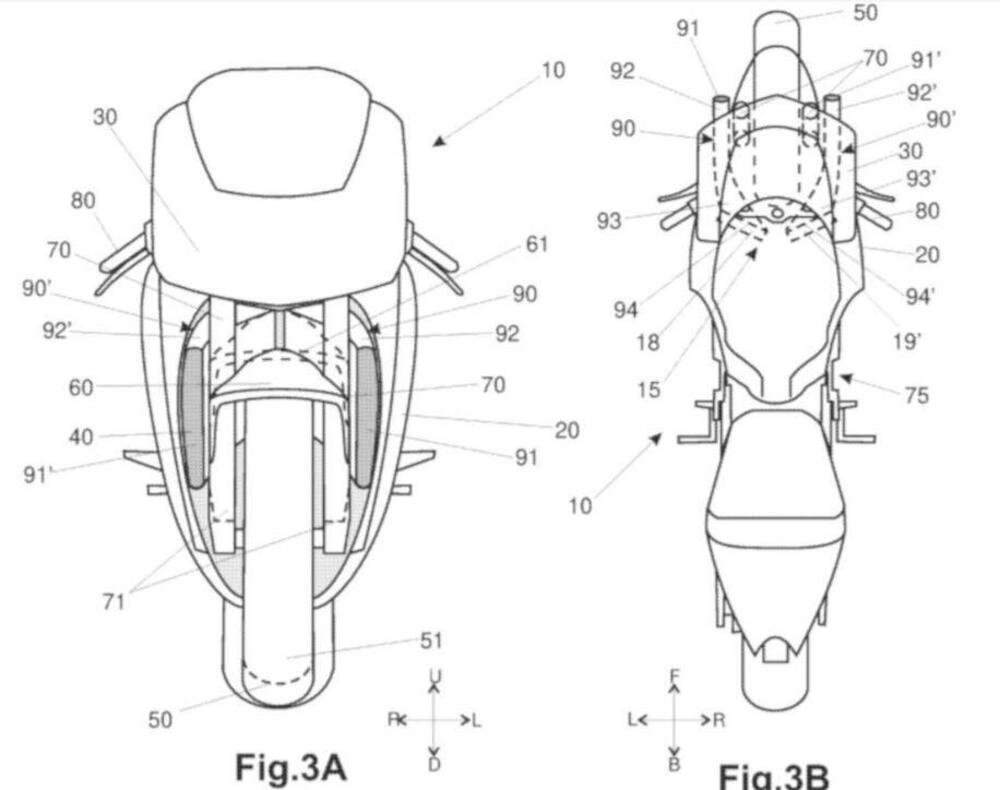
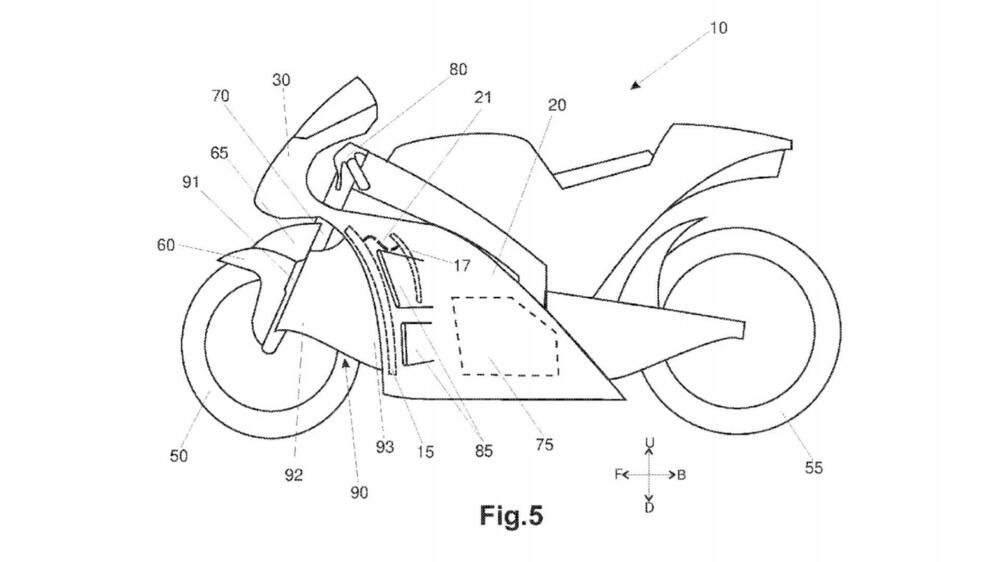
The ingenious system developed by Aprilia
Aprilia's idea, clearly illustrated in its new patent, is to route the air intake ducts forward of the radiator, along the front wheel, to expose the inlets to a non disturbed.
This, in turn, allows for smaller intake openings and the radiator itself, reducing weight compared to a conventional setup. Additionally, the design does not disrupt airflow over the exterior of the fairing, using forward-located air intakes while an extension on top of the front fender closes the air passage. air over the front wheel during acceleration as the fork extends, pushing air out to the sides and away from the 'parachute' shaped radiator opening. When the fork compresses during braking, the upper extension goes inside the fairing.
In this way, we achieve that, on the one hand, the front wheel does not prevent the air from reaching the cooling element and, on the other hand, that this part forms a very aerodynamic whole with the fairing.
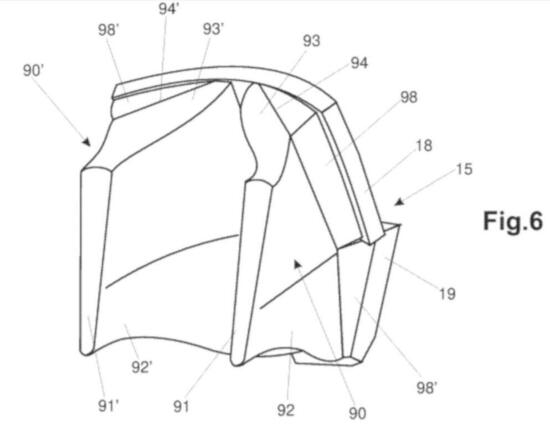
The key element of this system, which allows the air flow to be transported
The key element of the idea is the presence of the exaggerated air ducts on either side of the front wheel. It is not possible from a MotoGP regulations perspective to have a fairing in this area, under rules originally established to prohibit wraparound fairings, present decades ago, but until this year, there was a loophole that allowed “removable air entry” into this area.
Under the 2019 rules, the wording was as follows:
Seen from the side, it should be possible to see:
a) At least 180 degrees from the rear rim.
b) The entire front rim, with the exception of the part hidden by the mudguard, fork tubes, brake parts or removable air intakes.
This formulation clearly left an opening for design, particularly with regard to the removable air intakes. Like Ducati, which is accustomed to using loopholes in the regulations, this legal loophole was exploited by Aprilia to design a system with two air inlets, one on each side of the fork which transports it up to to the radiator.
But in the 2020 regulations, there is an update that places much stricter limits on fairing, replacing section b) with the following text:
b) The entire front rim (to this extent, the rim is the circular part of the wheel which fits the tire, except the hub and spokes), other than the part obscured by the mudguard front, fork tubes, brake parts or suspension clips.
With the exemption for removable air intakes, it appears that Aprilia's idea, shown in this patent, was killed before it had a chance to shine.
However, there is still a chance that someone will take advantage of this way of thinking, as the "removable air intake" loophole for the bodywork hiding the front wheel has not (yet) been changed in the regulations Moto2 and Moto3.
Aprilia's decision to patent this idea also suggests that it might consider putting it on a production machine with a similar setup. According to WSBK rules, this type of fairing would probably be legal provided that it is already present on its road-legal version. Additionally, patents are really meant to protect business ideas, not those used on racing motorcycles. It is rare to patent a design that is only used on a racing motorcycle, because rival teams could still copy it without violating the patent.
In WSBK, on the other hand, the requirement that competitors retain elements based on the road bike means that if this layout were used on a road machine and provided a real advantage on the track, it could be exclusive to Aprilia. Bearing in mind that a facelifted RSV4 could be in development, and that Piaggio – the group of which Aprilia is a part – is also working on ideas like active aerodynamics, it will be fascinating to see what technology Aprilia's future hyper sports car offers.
Sources: BikeSocial & MotoSan