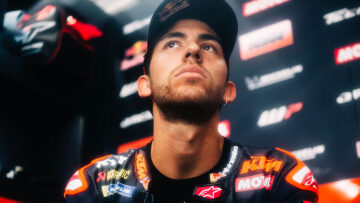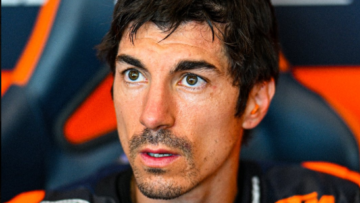






MotoGP has become a high-tech industry, where every millisecond is measured and every performance analyzed. But with this increasing professionalization, has the paddock lost some of its humanity? In a particularly revealing statement, Enea Bastianini laments the cooling of relations between riders and teams. Behind the lap times, the contracts, and the results, the Italian reminds us of an obvious truth that modern sport sometimes seems to forget: under the helmet, there is a human being.
Enea Bastianini isn't talking about engine power, tires, or setup. This time, the Italian rider is addressing a much more personal topic: the place of man in a discipline that has become extremely demanding.
When asked by GPOne about what the public doesn't always understand about the world of racing, he gave an answer that went beyond his personal experience. " The first thing is that we too often forget how valuable a rider is . I'm not talking about myself, but in general ."
This statement raises questions in a championship where the drivers are the central figures of the spectacle.
Bastianini: " Even technicians forget that we are human beings. »
Bastianini continues with a particularly direct observation. " Often, even the technicians forget this, and they forget that in addition to being pilots, we are also human beings. "
This is not an attack on any particular engineer or team. Rather, it describes a general evolution of relationships within the paddock. The driver has become a constant source of data, performance, and results.
His sensations inform technical decisions. His lap times determine the direction of development. His mistakes are analyzed down to the smallest detail.
But his personal needs can sometimes take a back seat. And it is precisely this imbalance that Bastianini wants to highlight.
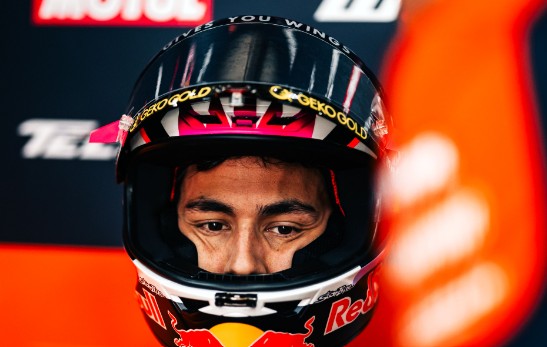
Bastianini: " The atmosphere has become much colder. »
The Italian makes no secret of his nostalgia for an environment that seems to have changed. " This atmosphere has become much colder. It may have been different in the past, but now it's a bit colder ."
He believes this evolution directly affects human relationships. " Even the relationship between the team and the drivers is affected . " Bastianini, however, doesn't reject the professionalization of the championship. He even acknowledges its logic. " Perhaps it's normal. Over time, everything becomes more professional. "
But this evolution, he argues, comes at a human cost. As structures become more complex, relationships between individuals risk being reduced to their functions. And the pilot may end up being seen more as a component of the system than as a person.
These remarks highlight the importance he now places on the quality of human relationships. Bastianini also explained that he consulted a sports psychologist to better manage fluctuations in confidence and maintain his equilibrium. This approach demonstrates that performance is not solely defined by physical and technical qualities.
« We are less concerned about the person's needs »
Bastianini 's conclusion is perhaps the harshest. " We care less about the individual's needs and we only see a number . " That says it all. In a championship where contracts are sometimes negotiated long before the end of a season, where careers can be turned upside down after a few poor results, and where manufacturers invest considerable sums, the pressure on the drivers is constant.
But an organization's efficiency does not necessarily guarantee the quality of human relationships. Yet trust between a leader and their team remains an essential element of performance.
Bastianini isn't calling for a less professional MotoGP . He's simply pointing out that professionalization shouldn't erase the human element. A motorcycle can be analyzed down to the last thousandth of a second. A rider, however, is more than just their number, their ranking, or their last race.