








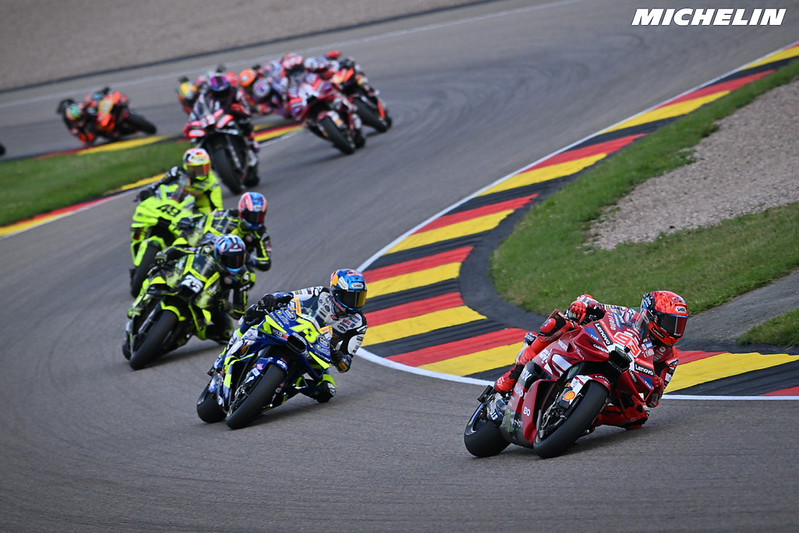
It hasn't been talked about much, but a major change took place during the German MotoGP Grand Prix: the starting grid has now been modifiedFollowing recent incidents, is this a step in the right direction, or, on the contrary, a misguided idea? Let's analyze.
A real problem
Let's start by laying the groundwork. Yes, at least one change was needed, because starts had become too dangerous due to today's motorcycles, which are veritable dragsters. We've seen far too many accidents during this crucial phase in recent seasons; In 2026, it was very heated in Catalonia with Zarco, and in Hungary with Martin.
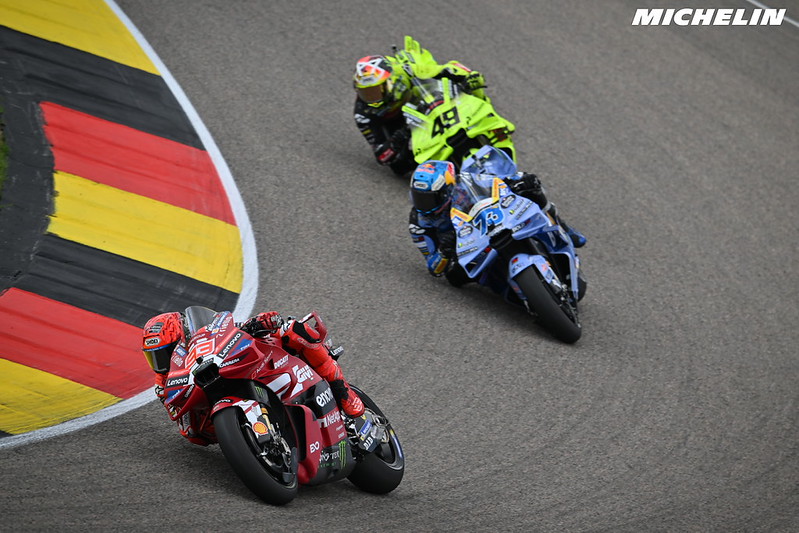
The first decision to be made was to ban the Holeshot Device; this has now been done since the Dutch Grand Prix. Some riders, including Marc Marquez, were a little worried about the consequences. because the majority of our heroes who arrived after 2019 have never known anything elseAnd it's true there have been a few slip-ups, but nothing too serious since Assen. Marquez was mainly worried that the front wheel would lose contact with the ground before braking, making deceleration even more difficult. But others thought the initiative was a good one. Personally, I'm eagerly awaiting the day when all devices of this kind are permanently banned.
To avoid pile-ups at the first turn, the MotoGP introduced a new grid at the Sachsenring. Previously, three meters separated first from second; now it's four. This means the distance between first and fourth (at the front of the second row) is increased to 12 meters, compared to three previously. The drivers, once again, were quite happy with this change. The problem is that it has not yet been tested under "critical conditions".
The departure is not exempt from physics.
Regarding the removal of the Holeshot Device, The main question in the paddock concerned these wheeliesAssen and the Sachsenring are two circuits where the first corner is very close to the start, and with short pit straights. Therefore, the test was passed, since this is precisely where the problem should have been most significant.
However, for the new grid – which Quartararo says will not change again until the end of the year –The Sachsenring did not present the most critical configuration. Let's do a little physics. There were 21 riders at the German GP. That represents exactly seven lines, therefore, 6×12+8 meters between the first rider, Marc Marquez, and the last, Cal Crutchlow. The grid therefore extended over 80 meters, compared to 60 meters previously. (6×9+6). These extra twenty meters open up the space, aiming to spread out the drivers in order to avoid having a compact pack at the first braking point.
The physical problem is that first place is always in the same position. As a result, the last cars reach a much higher speed than the first cars approaching the first braking point, and by quite a bit: After 20 meters and starting from a standstill, a MotoGP bike will be traveling at around 85 km/h, according to official telemetry..
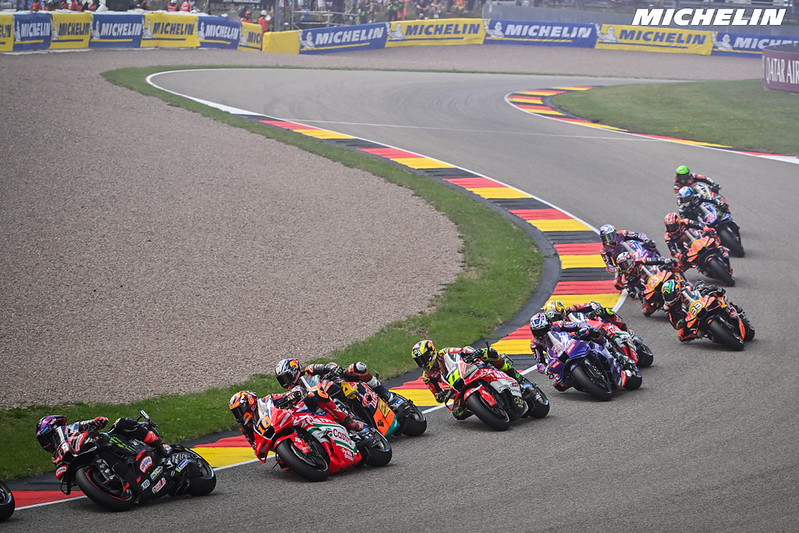
On a circuit like the Sachsenring, it's not so serious, because the speed is extremely low approaching the first corner, the drivers are in control, and an accident is less likely, except when the circuit itself is poorly designed (as in Hungary). But what will happen on more accident-prone tracks? are those with a huge starting straight and a first turn located very far away? I'm thinking of Malaysia, Catalonia (next year), Australia, or Qatar.
Drivers at the back of the grid will have to take the speed difference into account. because a difference of 20 meters radically increases their kinetic energy and momentum.
I did some calculations – which I'll spare you – using mass and average speed data provided by MotoGP, and the difference is very significant. To put it simply, the extra effort the last rider has to make approaching the first corner to dissipate energy under braking is much greater than before, while the speed difference, for a circuit like Sepang (I estimated the braking point to be about 510 meters ahead of first position on the grid), is about 10 km/h, compared to about 6 km/h previously, not counting the slipstream from the pack which benefits the last rider but not the first! All this to say that we will need to be very careful on these routes..
Any changes to the entertainment?
Let's leave the mathematics aside, and talk about the spectacle: this was the main question of Alex Marquez, who claimed to have doubts about the attacks in the first corners. And, indeed, we saw a difference at the SachsenringThe top five in the Sprint consisted of the same five drivers as at the start. The ventilation on the grid was clearly visible on screen, but if it helps prevent accidents, then we'll have to get used to it. As a general rule, safety must take precedence over entertainment.
Here again, the track profile must be taken into account. The greater the distance between the starting line and the first corner, the less this effect will be, as the drivers will have more time to position themselves, get a small slipstream, and try to attack. At the Sachsenring, as at Motegi for that matter, they dive straight in, and yet, some have gained places Raul Fernandez, for example, overtook Fabio Di Giannantonio at this spot on Saturday.
I'm curious to hear your opinion on this new grid. Tell me in the comments!
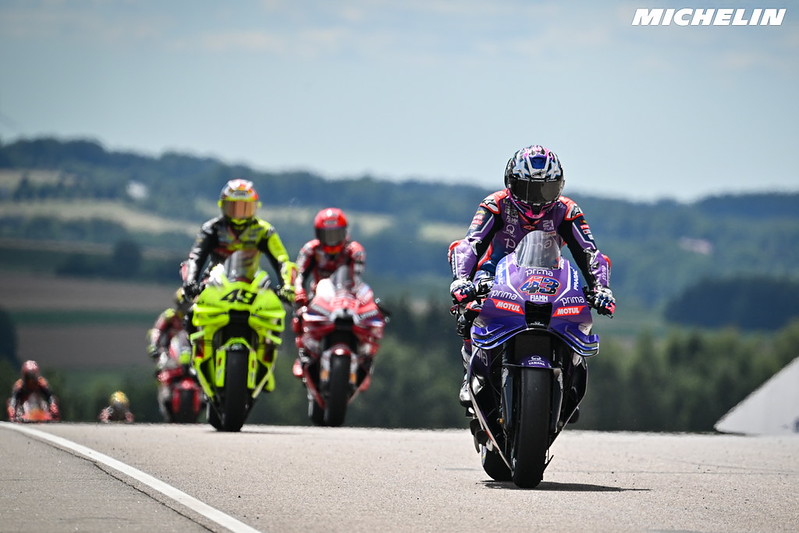
Cover photo: Michelin Motorsport