








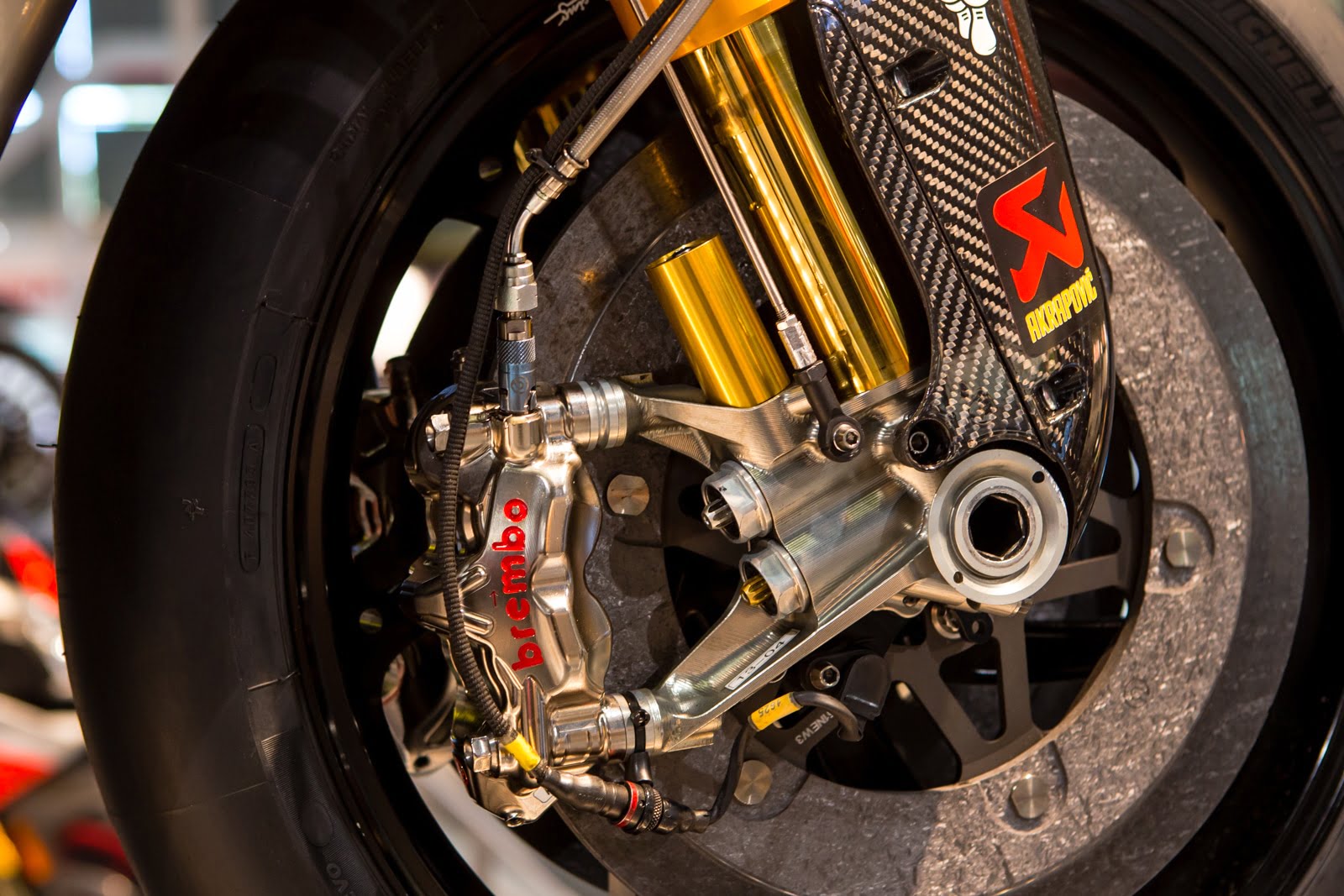
The unsprung mass, sometimes called unsprung weight, constitutes the mass of the vehicle's elements following exactly the undulations of the road. In contrast, the mass of the other elements of the vehicle, suspended on the wheels, is called “sprung mass”.
On a motorcycle, unsprung weight includes the wheels, tires, brake rotors, calipers, lower fork tubes, and part of the swingarm. Sprung weight is everything supported by the shocks – engine, chassis, fuel and rider.
This unsprung mass is important because it is closely related to the suspension's ability to keep the tires on the track.
We must return to Caesar…
A simple example: a horse chariot, used for chariot racing in Ancient Rome, has no suspension, so all of its weight is unsprung. Thus, the entire tank must follow the undulations of the track, which causes difficult driving. If the horses are moving and the chariot's wheels hit a large enough bump, the wheels can momentarily leave the road, with only the effect of gravity bringing them back to the ground.
A little theory
The heavier the wheel, the more energy is required to set it in motion or stop this same movement. Thus, a heavy wheel requires more torque from the motor which will limit acceleration. Conversely, a lighter wheel allows for faster acceleration.
It is easier to stop a 1 kg wheel from rotating than a 100 kg wheel because it develops less inertia. The heavier the wheel, the less effective the braking is. Without forgetting the essential grip when braking…
What's more, the wheel is an unsprung, rotating mass. An object in rotating motion gains inertia. The total kinetic energy E of a wheel is broken down into two contributions:
– Translation energy, because the wheel moves forward. This kinetic energy depends on its mass and its translation speed (1/2.m.v²).
– Rotational energy, because it rotates. A rotating mass has a kinetic energy which depends on its moment of inertia and its speed (1/2.J.w²).
With m: mass of a wheel / v: translation speed / J: moment of inertia of the wheel / w: rotation speed
For a cylindrical shape of radius R (approximation of the shape of a wheel of mass m) we calculate the moment of inertia as follows: J = 1/2.m.R²
Using the following relationship to make the link between linear speed and rotational speed: v = R w, then the equivalent mass M added to the vehicle by each rotating wheel is deduced from:
1/2 M.v² = 1/2 (1/2.m.R²).(v/R)², which gives M = 1/2 m
This means that each wheel adds, due to its moment of inertia (rotation), an equivalent mass M = 1/2 m to the vehicle. This comes to the total for the 2 wheels of a motorcycle to add: T = 2.M = 1.m. In other words, the equivalent mass of the wheels (m = mass of a wheel) on a motorcycle is therefore equal to 2 m + 1 m = 3 m (2m of static mass and 1m due to rotational inertia).
By repeating all the calculations, by being able to lighten the two wheels by 2 kg, we save 1 kg of inertia, which is far from negligible.
If the unsprung mass is significant, the wheel will have difficulty following the undulations of the road: an undulation effect will be created while it is absorbed by the shock absorber. If the inertia exceeds the absorption capacity of the shock absorber, the wheel could take off at each imperfection in the road, or even perpetuate the oscillation (and cause chattering). The lower the unsprung mass, the more easily and quickly the shock absorber will catch up with the phenomenon and the more the tire will maintain contact with the ground.
Thus, the mass of the wheel being lower, we can increase the hardness of the damping accordingly in order to take off less behind the bumps. We then enter the virtuous circle: the tire can be more flexible since it has fewer irregularities to follow, and therefore lighter. The rim will be all the better suspended. Springs and shock absorbers will undergo less significant forces since they have less inertia to contend with and can be dimensioned more lightly. The bike is lighter and has better grip.
Analogy with the engine
There is an analogy to be made here with valve panic (which can be compared to valve “floating”). The engine's intake and exhaust valves are actuated by rotating cams, and the cam lobe is nothing more than a sort of "bump in the road", except that it is very sleek. The valve spring is stiff enough to keep the valve mechanism in contact with the cam lobe normally, but if the engine revs too high than was sized, the cam can spin so quickly that the valves “float” on the cam profile for an instant. This panic of valves follows the same laws as the wheels of vehicles passing over bumps.
In the case of valves on an engine, engineers seek to make the moving parts as light as possible so that the valve spring can remain in contact with the cam. The same thing is done with the unsprung mass of a motorcycle.
What are the solutions ?
There is no miracle solution, you have to save weight on all non-suspended elements.
The rim is made as light as possible by making it from aluminum or even magnesium. The tires diagonals from the 1970s weighed up to 4.5 kg each, with the added weight of an inner tube (add a good kilo per tube). The arrival of tubeless rims in the 1980s banned the inner tube and the transition after 1984 from diagonal tire construction to semi-radial construction made it possible to reduce the weight of each tire by a good 1.5 kg.
The wheel axles solid, heavy but too flexible, have been replaced by lighter but also more rigid tubular axles.
The brake discs in 1972 were 7 mm thick. They have since been replaced by much lighter and narrower 5,5mm thick discs. In the case of MotoGP, the metal is replaced by discs made of carbon ultra-light (even in the rain).
The brake calipers have also evolved a lot. In the early 1970s, they could weigh up to 1.5 kg each. But through sizing and stress analysis (via CAD, Computer Aided Design), they have been refined to weigh much less – around 500g – while still having the rigidity to give excellent brake lever feel .
As for the fork herself, she became reverse, that is to say with the part containing the oil at the top so that it is the light part (the piston) which is not suspended. It's even better with shock absorbers with a separate oil reservoir, fixed to the chassis and therefore fully suspended.
If we return to the analogy with valves, the lightweighting process amounts to the transition from rocker arms and their rods to lightweight valves with overhead camshafts. In the old system, the cam raised a lifter or cam follower, which in turn raised a push rod. The push rod tilted the rocker arm, the far end of which, bearing against the end of the valve stem, raised the valve.
But in a modern overhead camshaft system, the added weight of the pushrod and rocker arm is gone, and the cam operates the valve directly, at worst via a very light detent, requiring only half the pressure of the valve spring to prevent valve float and keep the valve in constant contact with the cam lobe.
So, by lightening the unsprung weight of the motorcycle, more speed is required to "float the tires" on a given rough road, and when a tire momentarily leaves the road surface, it returns to contact much more quickly .
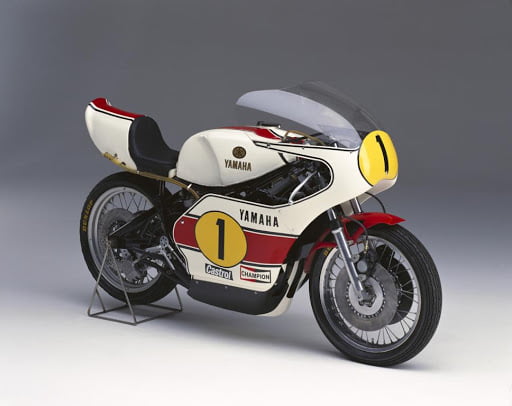
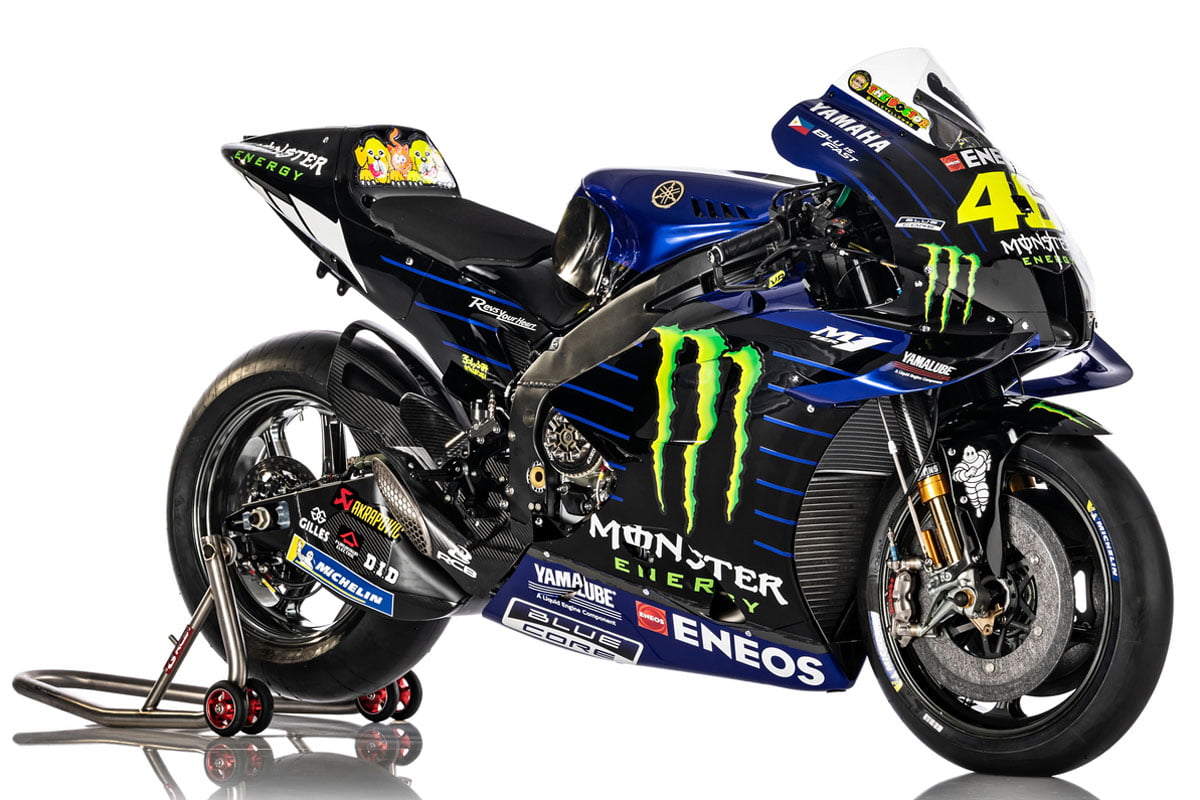
Let's go back to some theory... Acceleration, which is calculated in G, is the ratio between the mass of the accelerated object and the force which is necessary to accelerate it (in this case, the force of the spring of the suspension). A MotoGP bike weighs around 250 kg (with its rider), and considering that the weight is distributed evenly, this means that each wheel supports 125 kg. Assuming the unsprung mass is 12,5 kg per wheel (to simplify the calculations), then if the wheel "floats" after going over a bump, it would take 125/12,5 = 10 G to bring it back to the track contact. Imagine if the unsprung assembly weighed double that, or 25 kg, the acceleration needed to bring it back to the ground would be 20 G, also double that!
This clearly shows that a motorcycle with low unsprung weight can go through a rough corner much faster, without "wheel float", than one with heavier wheels.
This also explains why motorcycles with some lateral flex in their chassis can have higher cornering speeds (at a high lean angle) than motorcycles with a stiffer chassis. A chassis is rigid because by definition it cannot flex, bouncing over bumps, losing contact with the road surface and jumping sideways. A more flexible chassis allows the flex of the fork or swingarm to compensate for the bump rather than taking it. This flexible chassis allows the tires to better absorb small bumps.
Why doesn't suspension alone handle this? With modern tires allowing lean angles greater than 60 degrees, the suspension moves in a quite different direction from the bumps (the bump being vertical to the track, when the bike is leaned the suspension works more or less horizontally). And even if we manage to model very complex physical systems, it is very complicated to precisely calculate this kind of phenomena, because nothing beats the feeling and the prowess of a driver on the track...