








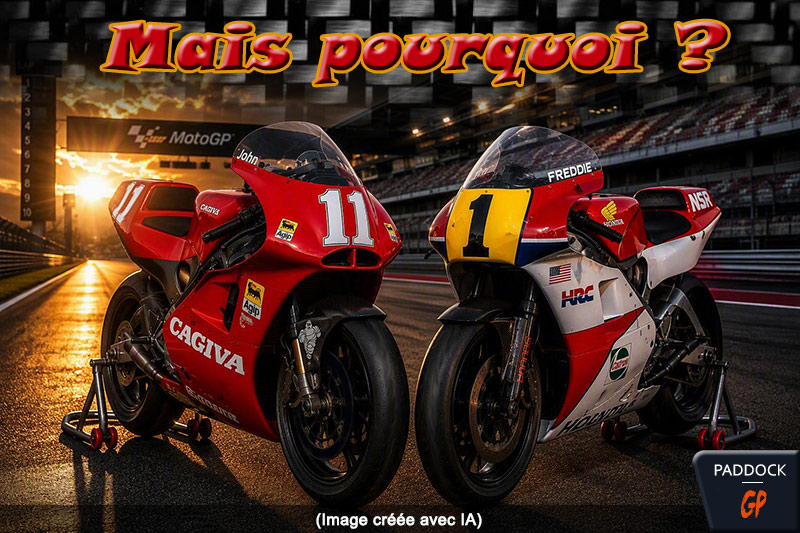
Carbon rims were long considered one of the most cutting-edge technologies in the World Speed Championship now known as MotoGP… until they were banned by the FIM.
Promising weight reduction, reduced inertia and gyroscopic effects, and therefore improved handling, they have attracted several manufacturers, starting with Honda et Cagiva, before disappearing permanently from Grand Prix racing. Their ban, however, did not result from a spectacular accident, but from a gradual evolution of the technical regulations officially aimed at reducing costs and strengthening safety.
Honda pioneer
Honda is often associated with the development of carbon wheels with the NR500 (1979-1983), NR750 and the early NSR500.
But in 1984, all four riders participated in the World Championship under a factory contract with Honda. Freddie Spencer, Randy Mamola, Ron Haslam and Takazumi Katayama, only Spencer benefited from the NSR500, a racing motorcycle equipped with a brand new V4 engine, the other three riding an NS500, a conventional model with a 3-cylinder engine.
The first-generation NSR500, whose development code was NV0A, made its competitive debut at the Daytona 200 in March, the most prestigious race in the American motorcycle championship. Despite numerous teething problems due to its engine architecture, it secured pole position in qualifying, the 499,2cc machine outperforming the Daytona-exclusive 695cc Yamaha YZR700 ridden by Kenny roberts.
She finished in 2nd position and was then entered in the world championship, which started in Kyalami, South Africa.
During the first qualifying session of the first round of the championship, the rear wheel of the motorcycle broke, causing an unexpected crash. Freddie SpencerHe injured the ligaments in his right ankle and fractured his left little toe, forcing him to withdraw from the first race of the season, despite being the reigning champion.
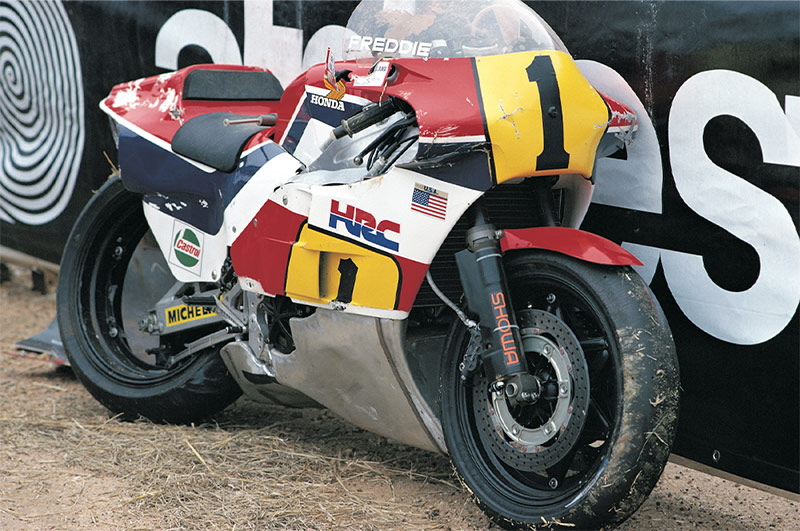 Photo: Shigeo Kibiki
At the time, HRC race bikes used Comstar wheels, specific wheels designed by Honda. The rim and wheel plate of the NV0A were unique pieces made of CFRP (carbon fiber reinforced polymer) joined by metal elements. Although HRC had been using these carbon Comstar wheels since the previous generation, the NS500, some feared they wouldn't withstand the increased power of the NSR500's V4 engine and might break.
The damaged wheel had been used at the previous Daytona race. The bike had briefly crashed there but was still able to continue racing. According to HRC's analysis, the damage likely worsened in the final laps, and the wheel broke before reaching South Africa.
The Japanese manufacturer stopped its experiment there, judging the risk/reward ratio to be unfavorable.
Cagiva also played an important role in the history of carbon wheels in Grand Prix racing.
In the early 1990s, the Cagiva bikes competing in the 500cc class already used carbon fiber frames and rims, designed by Piero Ferrari (Enzo's son). The objective was clear: to reduce unsprung mass and gyroscopic inertia in order to improve the motorcycle's responsiveness in changes of angle.
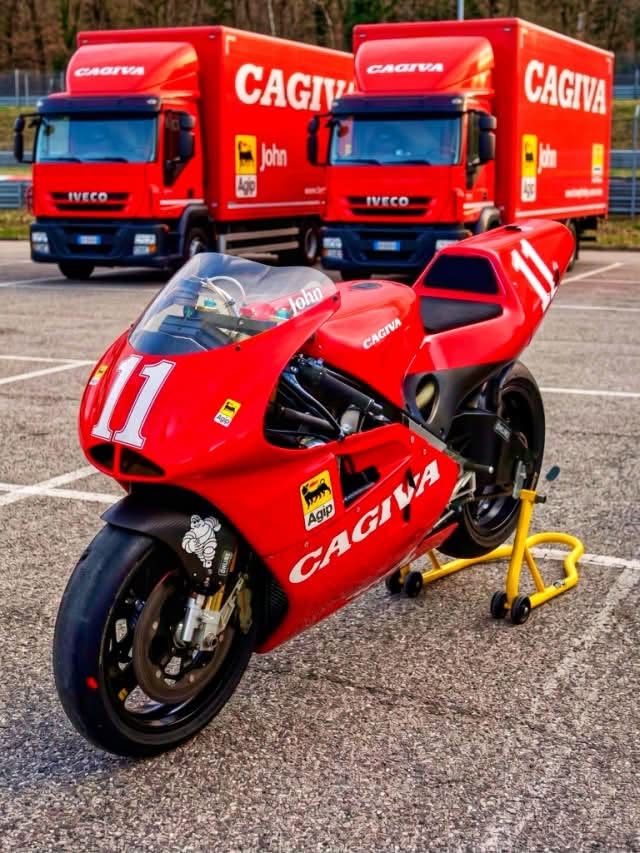
At that time, Cagiva was multiplying technical innovations to try to compete with Honda, Yamaha and Suzuki. The carbon wheels (3,5 x 17 inches and 6,0 x 17 inches) of the C593 were part of this quest for performance (as were later new generation aircraft-grade aluminum frames or 320 mm carbon-carbon discs).
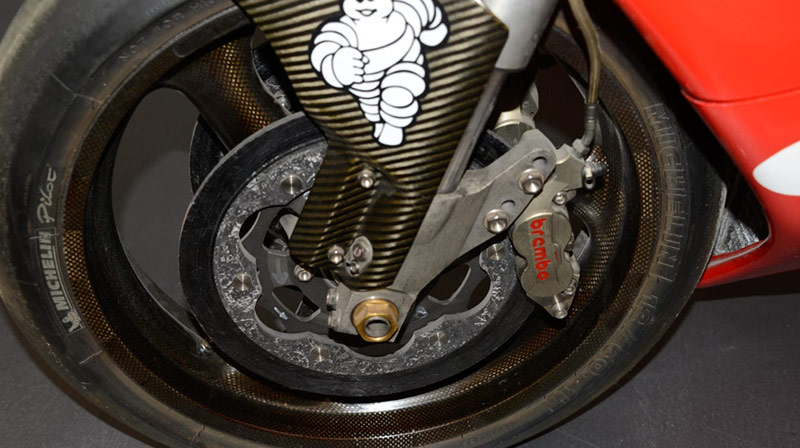
However, as with other manufacturers, the benefits were offset by several disadvantages: a very high manufacturing cost (at Ferrari), delicate maintenance and above all a complex inspection after a collision, a slightly forceful passage over the kerbs or even a simple tire change…
Unlike a lightweight alloy wheel that can deform, a carbon rim can suffer internal damage that is invisible after a simple impact against a kerb or during a tire change. These micro-cracks are difficult to detect and can then lead to a sudden break at any time. Added to this were a very high manufacturing cost and more complex maintenance during Grand Prix weekends, where wheels are repeatedly removed and reinstalled.
A natural evolution
These significant limitations, along with other more minor ones such as the problem of heat transfer, alongside the progress made on the forged magnesium rims
produced by Dymag and then Marchesini, greatly reduced the advantage of composite wheels, including in terms of weight.
The FIM therefore did not have to ban carbon wheels following an accident, but did so much later in the name of economic cost.
The first step came with the creation of Moto2, in a period when MotoGP was far less flamboyant than it is today, as illustrated by the creation of the hybrid CRT…
On December 11, 2009, the Grand Prix Commission published the technical regulations for the new category, which from its inception prohibited composite wheels.
Moto3, created in 2012, immediately adopted the same rule.
MotoGP, however, remains authorized to use this type of wheel until the end of the 2012 season.
The turning point came during the Grand Prix Commission meeting of 13th December 2012in Madrid.
The official statement simply reads: "Carbon composite rims are not allowed. (As is already the case in Moto3 and Moto2.)"
From the 2013 regulation onwards, the provision is harmonized for all categories: "In all categories, composite construction rims (including those made of carbon fiber, fiberglass, or any other similar composite material) are not permitted."
This ban was also part of the cost control policy pursued by Dorna and the FIM in the early 2010s, which would lead to the single ECU, the limitation of engines and several other technical restrictions (except for the exorbitant seamless gearboxes, of course…).
A short page in the history of the Grand Prix
Carbon rims ultimately had a relatively short period in Grand Prix racing, but they remain associated with an era when manufacturers explored the most daring solutions without limits.
Honda, but also the Cagivahave largely contributed to demonstrating the potential of this technology. While carbon wheels have disappeared from world circuits, they remain a symbol of the innovation that characterized the 500cc prototypes of the 1980s and 1990s.
Today, the regulations only allow magnesium or aluminum alloy wheels, definitively closing the chapter on composite rims in the World Speed Championship.
And for the road?
Today, if you love beautiful things and have deep pockets, several manufacturers offer carbon rims for your standard motorcycle.
Be careful though, there are more and more potholes on our roads (the potholes, not the chickens)...
Dymag - UK
Thyssenkrupp Carbon Components - Germany
BST (Blackstone Tek) – South Africa
Rotoboxes – Slovenia
C-Inertia - France