








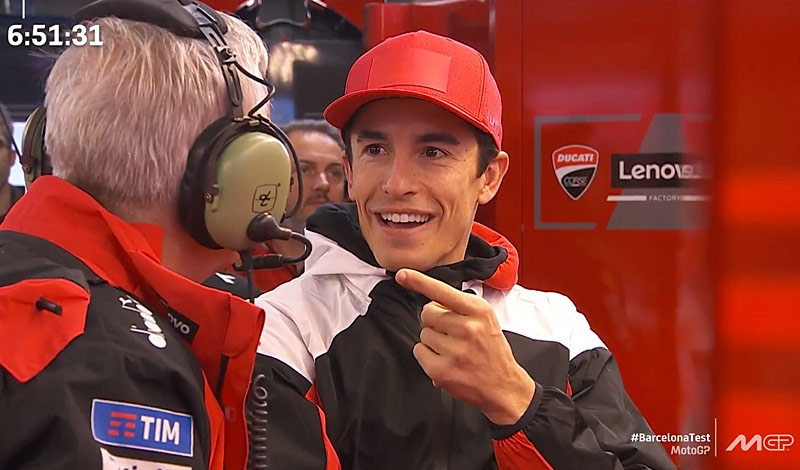
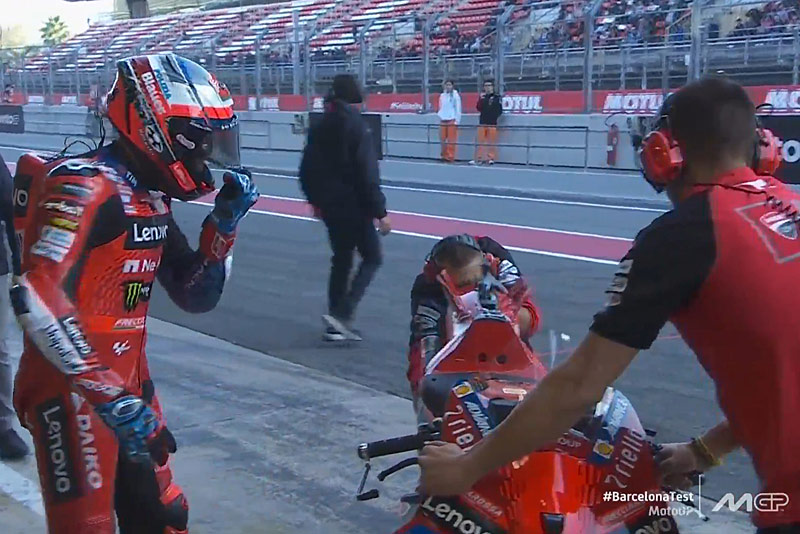
During the last test MotoGP In Barcelona, everyone could see Davide Tardozzi communicating by radio with Michele Pirro on his motorbike, to the surprise of Marc Marquez.
A few hours earlier, we were able to take stock of this subject with Dominique Hebrard, Manager of the FIM International Technical Commission, knowing that radio communication was only the tip of the iceberg...
Discover here all the details of the work currently being carried out by the FIM and what the safety devices of tomorrow will be: a rider who falls and automatically triggers the stopping of the race, it will no longer necessarily be science fiction...
Dominique Hebrard, we will start from what the press knows, which is to say not much. There will be tests of the communication system with a few drivers in static mode on the Monday following the last Grand Prix, then in dynamic mode on the Tuesday of the test. From what we can think, the project would have been rather pushed by Liberty Media. And besides that, in parallel with that, encouraged by the FIM, so for safety, the use of accelerometers in helmets…
Dominique Hebrard: "At the FIM level, we only work with Dorna, not at all with Liberty Media. At Dorna level, we have been working together for over a year and a half now on discussions regarding the integration of radio communication in helmets. This is a fairly complex subject because FIM-approved helmets (Phase 2019 – FRHPhe-1) have been used in MotoGP since June 01. From January 1, 2026 we will be on FIM approved helmets (Phase 2 – FRHPhe-02). What you need to know is that all these helmets follow a strict FIM homologation procedure. They undergo impact tests at the University of Zaragoza laboratory in Spain to be able to pass the required test criteria in order to be FIM homologated, see below:
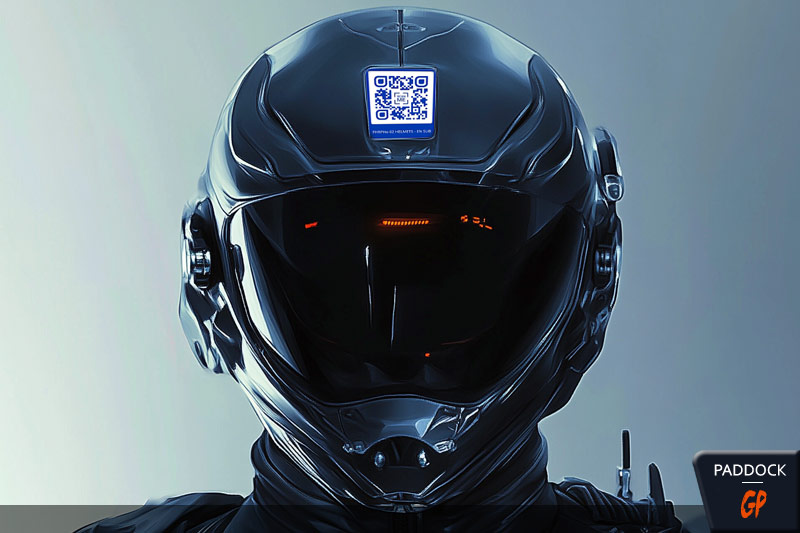
So obviously if we integrate a new system into a helmet, we must be certain, through a scientific evaluation, to know what possible impact any new system can have on its FIM homologation. Today we are at this stage.
The roadmap is that tomorrow we will equip and test helmets in static mode and we will ride on Tuesday to do dynamic tests. The objective is to see how the radio systems behave according to the different drivers who will be tested. And the roadmap is in several stages, for the moment over 3 years. The first step is to optimize the system to miniaturize it as much as possible, so as to integrate it as best as possible so that it is as comfortable as possible and as effective as possible for the pilots. What was tested on Monday and Tuesday was only radio communication. When we talk about radio communication, for the moment it is essentially unidirectional. Confirming the comfort and effectiveness of the latest system will be the subject of these tests. What is important for us is firstly that the pilots are comfortable with it. We are still in the development phase so the system is not finalized, as much in terms of the speakers that will be integrated into the comfort paddings, as the microphone that will be integrated into the helmet.
In this project, the radiocommunication part interests Dorna for questions of championship development. On the safety side, we at the FIM are pushing hard with the FIM medical commission and Dorna for the integration of accelerometers.. This will be in the second stage of the project, so that we can record during falls the accelerations and rotations that we can have around the different axes during a fall. You probably know this but this technology has already been used in F1 and in other disciplines for several years. Once we have this information, accelerometers will be integrated either in the speakers that will be integrated in the comfort paddings or on a second option to integrate them in the earplugs. The objective is that we can be more reactive depending on the severity of the crash to work jointly with the medical team and the race direction to intervene as quickly as possible and make the best possible decisions based on concrete data.
To summarize: step 1, radio communication, optimization and system integration, validation by scientific approach, that's where we are today. Step 2, integration of accelerometers, so that we can, from a medical point of view, have a rapid and effective assessment of the impact during a crash and the possible condition of the pilot."
It is said that the radio will already be active next year, maybe not at the beginning of the year, but during the year, at least in the Race Direction-driver direction, even if the following year the driver can respond or say “OK, I heard”, and the following year maybe the team-driver for instructions. The accelerometer, in that, when does that fit in?
“Once again, we are on the development of the validation protocol of the first system. The roadmap is quite clear over 3 years. Indeed, there is communication for example from the race management to the driver, that is a first step. Then the 2nd step is communication from the driver to the race management, so bi-directional, and step 3 will possibly be an opening to a team manager, but that will really be on the last phase of the project."
MotoGP radio MotoGP radio MotoGP radio