















Second round of the FIM World Championship MotoGP 2026, the Estrella Galicia 0,0 Grand Prix of Brazil marks the return of the championship to Brazil, at the Autódromo Internacional de Goiânia – Ayrton Senna, a A completely resurfaced circuit and a new one for Michelin Motorsport. The pneumatic allocation was defined exclusively from simulations, whereas theThe highly asymmetrical configuration of the track, with nine right turns and five left turns, generates strong stresses on the right shoulder of the tires.
After the season opener in Thailand, the 2026 FIM MotoGP World Championship heads to South America for the second round of the calendar, held from March 20 to 22 at the Estrella Galicia 0,0 Grand Prix of Brazil, at the Autódromo Internacional de Goiânia – Ayrton Senna.
This event marks the return of MotoGP to Brazil, a country historically passionate about motorcycle racing. Located in the city of Goiânia, in the heart of the country, this circuit previously hosted motorcycle Grand Prix races in the late 1980s and returns to the calendar in 2026 after significant modernization work and a complete resurfacing to meet current FIM and MotoGP standards.
Included on the calendar for the first time in recent years, this track represents entirely new territory for Michelin Motorsport. As no testing has been conducted there, the tire allocation was determined solely through numerical simulations that identified speeds, stress zones, and the circuit's key characteristics.
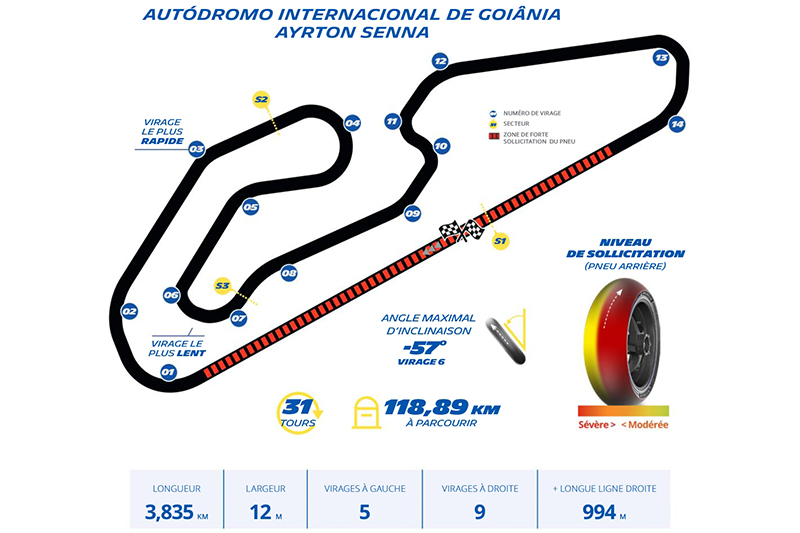
The 3,835-kilometer Autódromo Internacional de Goiânia – Ayrton Senna features nine right-hand and five left-hand corners, making it a particularly asymmetrical circuit. Simulations have shown that the motorcycles spend a significant amount of time leaning to the right, with over fifty seconds of cumulative stress in this configuration over a full lap.
This characteristic, combined with fast curves that are mostly right-handed, leads to A significant temperature increase on the right shoulder of the tires. Simulations indicate that thermal stresses could be particularly high there, placing this circuit among the most demanding on the calendar for tires.
To address these specific constraints and the uncertainty associated with discovering a new route, Michelin Motorsport has chosen to offer an expanded allocation.
Michelin's partners will have three types of MICHELIN Power Slick asymmetric front tires – Soft, Medium and Hard – with a more resistant compound on the right shoulder, in order to better respond to the imbalance of stresses between the two sides of the tire.
At the rear, three asymmetric options will also be offered. Two of them will benefit from a reinforced carcass identical to that used on the Red Bull Ring circuit in Austria, combined with a more resistant compound on the right shoulder in order to withstand the high loads generated during long cornering phases.
A third rear option will also be available. It will retain a harder compound on the right shoulder but will use a different carcass, already used on circuits like Buriram or Mandalika, allowing for lower temperature generation and keeping the tires within an optimal operating window.
This expanded allocation – three options at the front and three at the rear – differs from Michelin's usual strategy, which generally offers two options per axle on circuits with more conventional constraints.
To allow drivers and teams to better familiarize themselves with the new track layout and evaluate the various tire options, Friday's practice sessions will also be longer, with increased track time. Michelin will provide a larger selection of tires than during a typical race weekend: six Soft, six Medium, and six Hard tires for the front, and eight Soft, six Medium, and five Hard tires for the rear. Each driver will be able to use 12 front and 14 rear tires over the weekend.
« Goiânia represents an unprecedented challenge for us. ", explain Piero Taramasso, manager of Michelin Motorsport's two-wheeled competition. We've never raced there in MotoGP and we haven't been able to organize any tests, so all our preparation is based on simulations. They show a very asymmetrical circuit, very demanding, especially on the right side. »
« To address these constraints and the uncertainty associated with a new layout, we have provided Brazil with an expanded allocation of three front and three rear specifications, all asymmetrical.. In addition to a reinforced tread pattern on the right side, like the front tires, the rear tires feature a reinforced structure for better temperature control. This will give teams more options to find the best balance. »
« On this new circuit, the drivers who learn the racing lines and tire behavior most quickly will certainly have an advantage. Finally, we are very happy to be returning to Brazil, a country with an extremely passionate and welcoming public. »
From a meteorological perspective, March is a relatively humid month in the Goiânia region. Air temperatures are expected to range between 20°C and 30°C, relatively moderate conditions for MotoGP, but the risk of rain remains high due to the circuit's geographical location.
In case of wet track conditions, Michelin will make available its MICHELIN Power Rain range, in Soft and Medium compounds, symmetrical at the front and asymmetrical at the rear.
The Estrella Galicia 0,0 Grand Prix of Brazil will begin on Friday, March 20th with the first practice sessions. The first Free Practice session will take place from 11:05 AM to 12:05 PM, followed by Practice from 15:20 PM to 16:35 PM.
Saturday, March 21st will begin with Free Practice 2 from 10:10 to 10:40. Qualifying will then take place with Q1 from 10:50 to 11:05, followed by Q2 from 11:15 to 11:30. The Tissot Sprint, a 15-lap race, will start at 15:00.
The Grand Prix, consisting of 31 laps, will start on Sunday, March 22, 2026 at 15:00 PM (local time).
Michelin MotoGP Brazil