








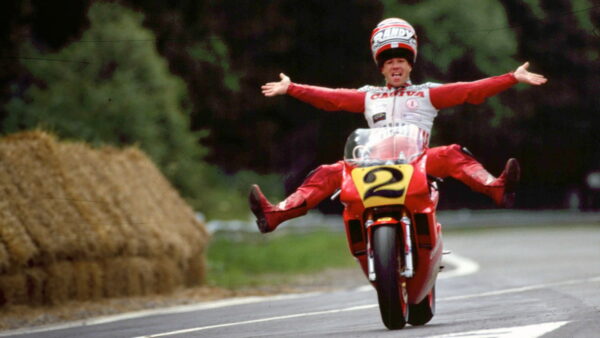
MotoGP bikes have never been so fast. Nor have they ever been so sophisticated. But this constant quest for performance has a downside, often invisible to spectators: riders now have to exert unprecedented physical effort to get the most out of their machines. This is the observation made by Randy Mamola, four-time 500cc World Championship runner-up and a privileged observer of the paddock for over forty years. For the American, the main culprit has a name: aerodynamics.
« Before, we were looking for speed. Today, we're looking for support. aerodynamic "…In a few words, Let's face it This perfectly sums up the evolution of modern MotoGP. In the 1980s, fairings were primarily designed to reduce drag in order to increase top speed. Today, the philosophy is completely different.
The wings generate downforce that presses the motorcycle to the ground during acceleration, braking, and cornering. This added stability allows for even greater speed… but it also places the rider under significantly increased physical strain.
According to Let's face itA current MotoGP bike can generate nearly 50 kilos of aerodynamic downforce in the fastest corners. A figure that illustrates the scale of the effort required of the riders. With each change of angle, with each hard braking maneuver, they have to move a machine that has become much more stable… but also much more physically demanding.
This evolution explains why even the best drivers sometimes seem exhausted after only a few laps. After five laps, they are already out of breath. " observes the former American pilot. A reality that television broadcasts often struggle to convey.
Let's face it It also reminds us that this development could have been anticipated much earlier. Long before that Gigi Dall'Igna do not make aerodynamics one of the major weapons of Ducati, Honda had already experimented with similar solutions. And the test riders of the time had delivered a clear verdict: the motorcycle became far too tiring to ride. The project was abandoned.
Several years later, Ducati He took up this idea, developed it successfully, and permanently revolutionized MotoGP. The other manufacturers then had no choice but to follow this technical revolution.

Randy Mamola: " Johann Zarco is developing the sensitivity needed to go fast in MotoGP »
For Randy MamolaThe differences become most apparent towards the end of the race. As the tires gradually lose their effectiveness, not all motorcycles require the same level of effort to maintain a high pace. When the tires wear down, the real battle begins.
With similar lap times, some drivers have to expend significantly more energy than others to stay in the leading group. This is a rarely discussed factor, but it can turn a race around in the final laps.
It is for this reason that Let's face it He welcomes the regulatory revolution planned for 2027. The reduction of aerodynamics, the removal of motorcycle trim correction devices and the arrival of the new 850cc could, according to him, give more importance to the rider's skill.
Less assisted motorcycles should be more physically demanding to ride, but paradoxically less tiring over time, due to the reduction in aerodynamic forces acting on them today.
The former driver also believes that this technical overhaul could allow Japanese manufacturers, who have been struggling for several seasons, to reduce some of their gap with European brands.
Despite technological advancements, Let's face it remains convinced that the real differentiating factor is still the "feeling" with the motorcycle. In his eyes, Marc Marquez It still represents the absolute benchmark in this field.
But he also emphasizes on Todocircuito the importance of the training provided at the VR46 Riders Academy. According to him, Francesco Bagnaia, Marco Bezzecchi and several pilots from the school of Valentino Rossi They owe part of their exceptional sensitivity to the "dirt track". That's where they really learn to slide the motorcycle, to feel the limits of the front and rear."A learning process that develops sensations impossible to reproduce on a simulator."
Let's face it also expressed admiration for the training method of Johann zarcoHe recounts having watched the Frenchman drive for almost an hour with only one completely worn-out tire. « He continues to drive endlessly with the same tireThat's how you develop the sensitivity needed to go fast.. » A way of working that illustrates the idea defended by the American: speed arises as much from feeling as from physical condition.
At a time when electronics, aerodynamics and simulations are playing an increasingly important role in the development of MotoGP, Randy Mamola This reminds us of an obvious truth that numbers cannot measure. Technology allows us to push the limits of machines, but it cannot replace talent, instinct, or a rider's ability to feel what their motorcycle is doing.
And while modern MotoGP bikes are the fastest in history, they are also, according to him, the most physically demanding the championship has ever seen. This is a reality that the technical revolution of 2027 could well begin to rebalance, by giving the rider a greater role in the performance equation.
