








Penalties are a problem. Rarely have we heard drivers complain so much about the inconsistency of race management regarding the application of sanctions before this season, but also about the opacity of the explanations linked to them. Since yesterday, we have been looking into the issue; first with a case study around the Jorge Martín “affair”. Reading this first part is strongly recommended; you can find it here. Today, let's continue our study by analyzing the very substance of MotoGP refereeing.
An impossible equivalence?
It is always tortuous to establish equivalence in non-binary sports, just like fouls in football. These disciplines depend on the interpretation of a referee, or a committee of referees. As these change often, it becomes impossible to establish perfect continuity. Furthermore, desiring perfect consistency often opens the door to conspiracy, because given that it is intrinsically impossible to achieve, the slightest contested decision becomes all the more decried (like VAR in football. “Interpretations contrary to the laws of the game” are more shocking precisely because the tool should better prevent them, or even eliminate them.).
So why, in the first part, were we criticizing the race management for not having inflicted anything on Jorge Martín following the contact with Luca Marini? After all, the interpretation of judges must remain sovereign to maintain the legitimacy of the decision-making body.
Quite simply because by not penalizing it, the race direction is not penalizing obvious contact between two drivers, with an increased risk of falling at this location. Whether Marini falls doesn't matter. Remember, the act, not the consequence. The history of sports teaches us that it is better, when possible, to be firm rather than cowardly. The actors must not dominate, but submit to the law of race direction. Clearly, it is better, in absolute terms, to penalize all contacts than to penalize none, for the sustainability and image of the discipline. Of course, it is not a question of reaching such extremes, but drivers should set off with the idea that all contacts will be reprimanded, rather than the other way around.
What should race management do, concretely?
We thought about three solutions that would greatly help the cause of the stewards.
- Explain yourself. As in American football (and soon in soccer), those whose job it is to interpret must be able to justify their interpretation. Obviously, the explanatory banner is not enough. Spectators and drivers alike demand more clarity. As with any legitimate body such as the police, we may or may not agree, but they decide, and argument always serves the cause. Why not imagine a group of two or three officials who would come, publicly, to answer questions from the press after each question in front of the camera, for better proximity with the public and so that we put a face to those who govern our sport.
- Make decisions quickly. Even if this is not the case, the race direction must give the impression that it is on alert, constantly. If the regulations had been applied more quickly, Luca Marini would not have fallen, or at least not in this way, because Jorge would have completed his long lap. But quick decisions go hand in hand with…
- ...The firmness. The judges must not doubt. When in doubt, always opt for the hardest option, without going as far as the dreaded black flag; the long lap is sufficient in case of strong contact. As the famous legal saying goes, Abundans cautela non nocet, “excessive precaution does no harm”. This only has advantages, because the legitimacy of the sports commissioners would be reinforced, and, on the other hand, because it is always easier to explain a harsh penalty for a case which deserved less rather than a absence of penalty for a case which deserved a light one. To choose a wronged person, as long as he is at fault, even slightly.
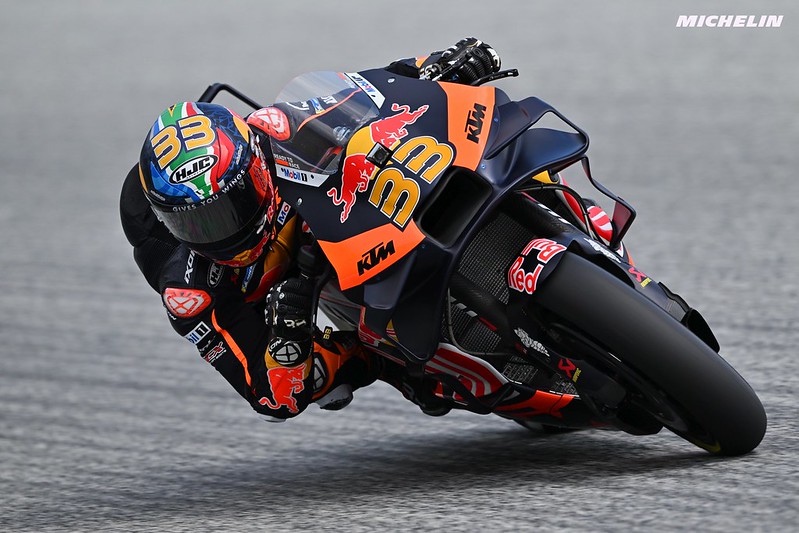
So, yes, we know that many appreciate muscular exchanges, but the passivity of the commissioners works against the science of overtaking; there are almost no artists left in this field. Many, like Brad Binder for example, brake hard, make contact at the apex, and thus pass (Jerez, Le Mans, among others). The fear of a stronger sanction would force pilots to find other alternatives.
Conclusion
We do not need more penalties but greater firmness. Let them be given quickly, and let those who apply them be able to explain them publicly.
What do you think ? Do you agree with our diagnosis? Tell us in the comments!
Cover photo: Michelin Motorsport