




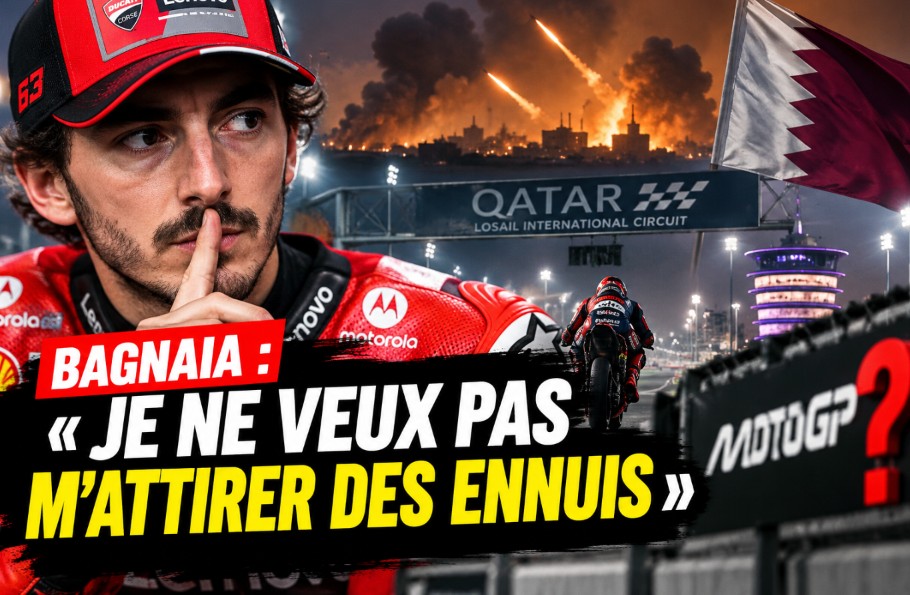
The Qatar Grand Prix remains scheduled for November 8th, despite military tensions in the Middle East. But in the paddock, the drivers' responses reveal a disquiet that goes beyond the mere question of the calendar. Francesco Bagnaia, when asked about the risks of traveling to Losail, uttered a striking phrase: "I don't want to express an opinion that could get me into trouble." This precaution was immediately followed by a crucial reminder: safety must come first. Why does a two-time world champion feel the need to take such precautions when addressing this subject?
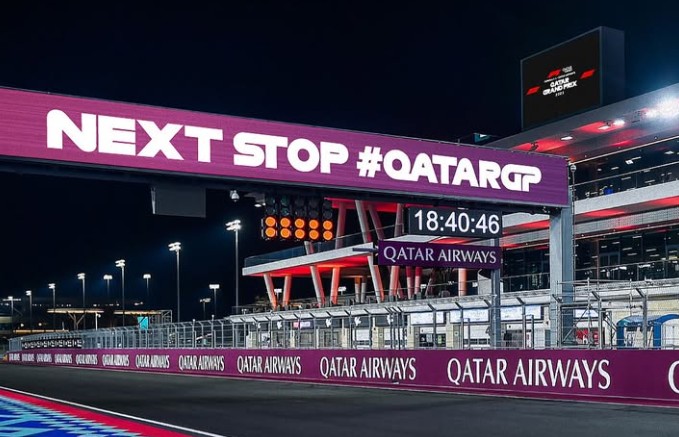
MotoGP wants to race in Qatar . It remains to be seen whether conditions will actually allow a Grand Prix to be held there. Originally scheduled for April, the event was postponed to the weekend of November 6-8 due to the regional conflict.
With less than a month to go before this new deadline, no cancellations have been announced. But statements gathered by Motorsport.com show that the drivers are approaching this trip with very different feelings. And Francesco Bagnaia 's deserves particular attention.
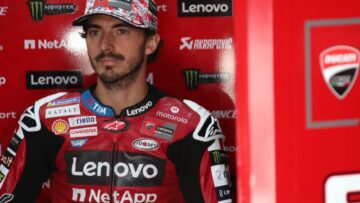
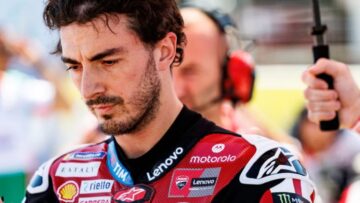
Bagnaia on Qatar: " I don't want to express any opinions that could get me into trouble. »
The Italian could have responded with a conventional formula, stating that he trusted the organizers. He chose a far more revealing opening. " I don't want to express any opinions that could get me into trouble. "
He then immediately clarified his position: “ However, if our safety is truly a priority, then all aspects must be carefully considered .” Bagnaia did not explicitly call for the cancellation of the Grand Prix. He even emphasized the qualities of Losail, its nighttime spectacle, and its unique atmosphere. But he added that if the conditions are not suitable, it is better to wait before making a decision.
The Ducati rider doesn't point the finger at anyone responsible for any potential pressure. Nor does he claim to have received instructions to remain silent. He does, however, reveal that publicly expressing an opinion on safety could, in his view, lead to unpleasant consequences.
In a sport where pilots are the first to be exposed to the risks of travel, this restraint raises a legitimate question: what place does their voice really occupy in the decision?
Quartararo downplays the situation, Marquez avoids commenting
The other reactions illustrate the lack of a common position. Fabio Quartararo doesn't express any particular concern. " I'm not worried about going to Qatar ." The Frenchman believes, in particular, that Formula 1's decision could serve as a benchmark.
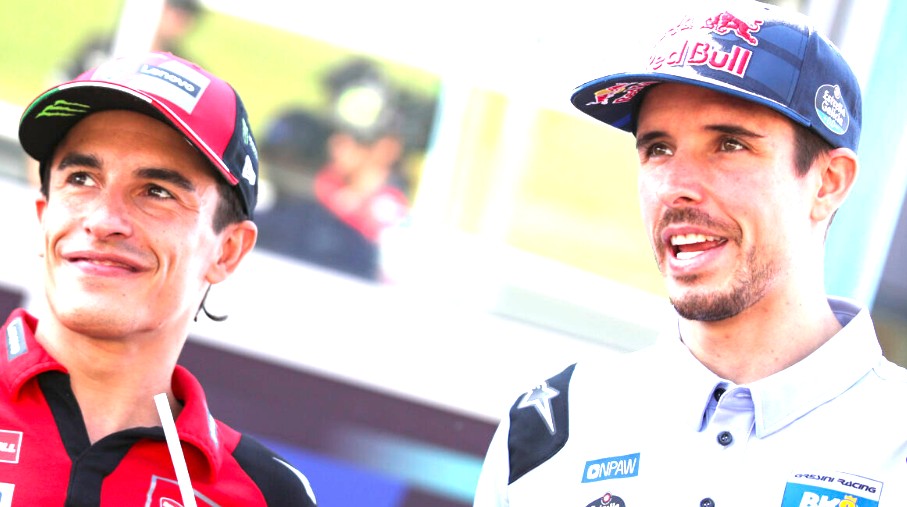
Marc Marquez , for his part, prefers not to publicly express his opinion. Jorge Martin is taking a primarily sporting approach. With only a two-point lead in the championship, the Aprilia leader knows that an additional race could earn him up to 37 points, but could also result in zero. However, he refuses to speculate on an event whose occurrence is beyond his control.
These reactions do not allow us to conclude that the pilots collectively wish to avoid Losail . Rather, they demonstrate how limited their room for maneuver appears to be in the face of a decision that rests with the organizers.
Can safety depend on the F1 calendar?
The comparison with Formula 1 comes up regularly in discussions. But it deserves to be examined with caution. The fact that another discipline maintains its schedule does not, in itself, guarantee the safety of MotoGP. Dates, regional conditions, protective measures, and risk assessments may differ.
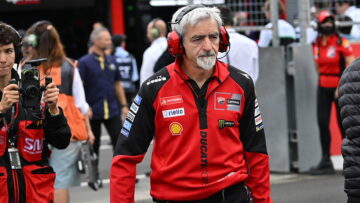
Carlos Ezpeleta , representing the MotoGP championship organization , assures that the situation remains closely monitored and that the safety of both staff and spectators remains the top priority. Contingency plans are also being discussed. At this stage, therefore, the race remaining on the calendar does not mean that all risks have been definitively eliminated.
Behind Qatar, a question of power in the paddock
The debate ultimately extends beyond the Qatar Grand Prix alone . Drivers are contractually obligated to race. Promoters must fulfill sporting, commercial, and logistical obligations. And teams must organize complex international travel.
But when the geopolitical context introduces a risk external to the competition, these interests no longer necessarily coincide. This is precisely what gives the Bagnaia Declaration its significance.
The two-time world champion isn't saying he refuses to race. He's saying he's hesitant to freely express his thoughts. And in a championship where safety is officially presented as a top priority, this hesitation perhaps deserves as much attention as the final decision regarding Losail.