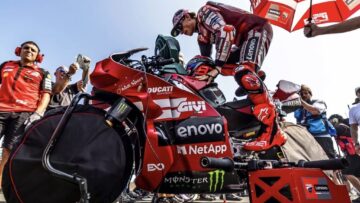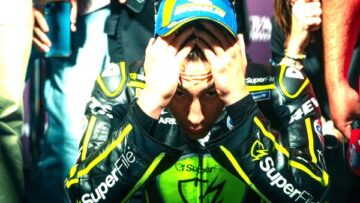





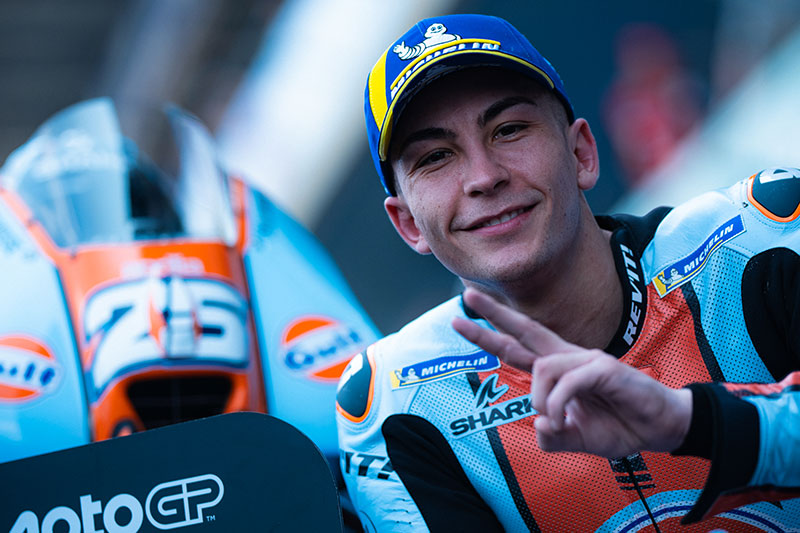
Indonesian Grand Prix: Raul Fernandez delivered a performance in Mandalika that went far beyond the sporting result. The TrackHouse rider had to adapt his riding style to a reduced hand, without sacrificing the potential of his Aprilia. This demonstration of adaptability impressed Andrea Dovizioso. Behind the podium, another dimension of MotoGP emerges: that of a rider forced to rebuild his reflexes to remain competitive.
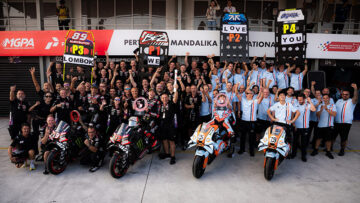
In the Indonesian Grand Prix standings, Raul Fernandez finished second, behind Marco Bezzecchi . A remarkable result for TrackHouse , amidst a historic Aprilia 1-2-3-4 finish.
But the results sheet doesn't tell the whole story. Fernandez competed in this race with two fractured fingers following his Sprint crash. And to continue riding, the Spaniard had to modify one of the most essential techniques in MotoGP: braking.
Two broken fingers, but still riding.
On a MotoGP bike, the right hand performs several tasks simultaneously. It controls the throttle, operates the front brake, and transmits some of the information from the motorcycle to the rider. At speeds exceeding 300 km/h, these movements must be precise, rapid, and perfectly coordinated.
A finger injury can therefore disrupt much more than just the ability to grip a lever. It can alter the available force, the precision of the application, and how the rider stabilizes their hand during deceleration. Yet Fernandez still started the Grand Prix.
It wasn't just a matter of enduring the pain. It was necessary to find a different way of performing movements repeated dozens of times per lap, without compromising control of the machine.
Relearning how to brake in the heat of competition
Modern braking isn't just about slowing down. It determines the motorcycle's stability, its corner entry, and the ability to maintain speed all the way to the apex. A change in technique can disrupt this entire sequence.
With his weakened hand, Fernandez had to adapt his approach to using the front brake. This requires a rare ability: replacing reflexes acquired over years with a solution immediately usable in a race.
Because a rider's brain largely functions through anticipation. Actions are prepared even before the motorcycle reaches the braking point. Changing the way these actions are executed, without losing one's sense of speed and trajectory, therefore represents a considerable challenge. It is this adaptive intelligence, as much as physical courage, that gives the result its added value.
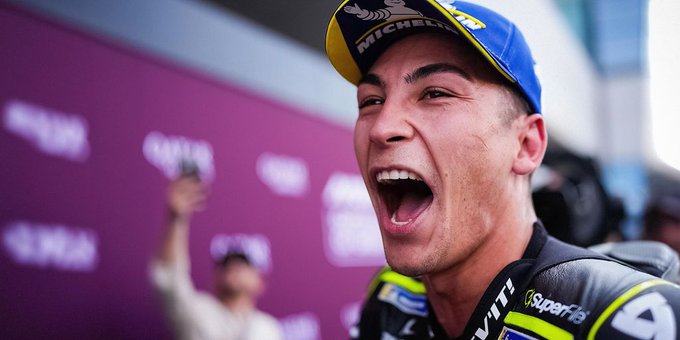
Dovizioso: the expert's eye is not mistaken
Andrea Dovizioso is particularly familiar with the braking requirements in MotoGP. A former rival of Marc Marquez and a benchmark in the art of controlling a Ducati entering corners, the Italian knows how much the precision of the right hand influences the entire riding experience.
In his analysis of Mandalika, he called Fernandez a "phenomenon." A particularly revealing judgment. Dovizioso isn't simply praising a rider who gritted his teeth to finish a race.
He acknowledges a technical feat achieved despite a major physical constraint. And that distinction matters. Courage allows you to start. Adaptation allows you to stay fast.
TrackHouse, much more than a satellite team
Fernandez 's performance comes at a significant time for Aprilia . At Mandalika, all four RS-GP bikes finished in the top four positions. Bezzecchi took the win ahead of Fernandez, Jorge Martin , and Ai Ogura.
This result confirms that TrackHouse is no longer just a structure tasked with filling out the grid. Its drivers are directly contributing to the Italian manufacturer's demonstration of strength.
But Fernandez added something that technical data cannot fully measure. He showed that a competitive motorcycle is not enough: you also need to be able to exploit its qualities when your physical condition no longer allows you to ride normally.
Talent is also about knowing how to adapt, Dovizioso reminds us.
Great pilots are often associated with their ability to repeat a perfect movement. Mandalika reminds us that another quality can be just as decisive: knowing when to temporarily abandon that movement to invent another.
Fernandez didn't win the Grand Prix. But his second place, achieved with an injured hand and adapted braking, says more than just a podium finish. MotoGP usually rewards those who push their machine to its limits. In Indonesia, Raul Fernandez primarily pushed the limits of his own habits.
And when Dovizioso speaks of "phenomenon", it is perhaps precisely this ability that he distinguishes: not just going fast, but finding how to continue to do so when the body no longer responds as expected.