








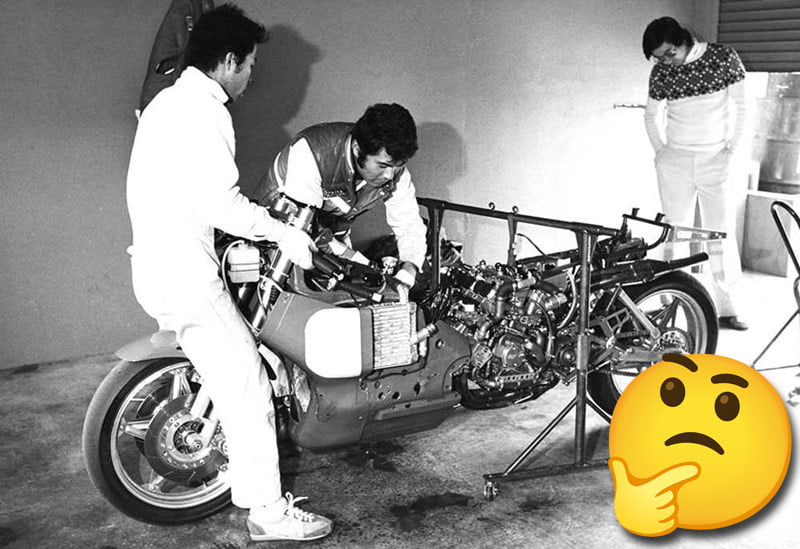
A l’occasion du Salon Moto Légende 2022, nous avions publié récemment quelques photos du très technologique Honda NR 750 engine , une moto fabriquée en 1992 qui était la version de route du prototype de compétition qui a essayé de s’opposer aux deux-temps en 1979 avec des solutions technologiques très novatrice : voici l’histoire de cette dernière, la Honda NR 500.
November 1977: Honda announces its return to the premier 500cc GP category, after twelve years of interruption!
A few days later, Koichi Yanase is appointed head of the Motorcycle Racing Department.
He is responsible for leading the project with three objectives:
[1] Create innovative technology for competition.
[2] Discover talented young engineers who would help Honda's development.
[3] Win the world title within three years.
In January 1978, Yanase recruited Takeo Fukui
(then chief research engineer at Wako R&D Center).
The latter begins the study of the engine with Shoichiro Irimajiri while Yanase is focusing on hiring around 70 people to carry out the project (we will reach around XNUMX people later).
Shoichiro Irimajiri is an aeronautical engineer who joined Honda in 1963. As a reminder, he already has a long history in competition, with the 1965 world titles in 50cc, 2 cylinders, 8 valves. Ralph Bryans, in 125cc, 5 cylinders, 20 valves Luigi Taveri, and in 250cc, 6 cylinders, 24 valves Mike Hailwood), 1966 and 1967 still with Mike Hailwood in 250cc.
Excuse a bit! Honda NR
500
![[Oldies] Honda NR 500 1979 Irimaj10](https://i.servimg.com/u/f25/13/15/94/65/irimaj10.jpg)
A new department is created and titled “NR”, for New Racing, at the Asaka research center.
Shoichiro Irimajiri manages, among other things, three engineers far too young to have known Honda's past experiences in competition, or indeed any competition. Among these, Toshimitsu Yoshimura, who has worked for the Japanese company for only six years, speaks today: “We weren't excited by the competition, but by the desire to create something that would represent the best technology. We wanted to create an engine that would surprise the whole world. We believed that by creating the most sophisticated engine, we would be victorious. »
At the time, the victorious 4-strokes from MV Agusta had given up for two years and the podiums were monopolized by the 2-strokes Suzuki and Yamaha developing around 120 horsepower. Although this is not a sufficient factor to win, Honda's primary objective is therefore to exceed this power.
Toshimitsu Yoshimura is a fervent defender of 4-stroke: “When I think about it, our ideas were a bit crazy, both for the engine and everything else. We wanted to create the difference that would give us a definitive advantage and we switched to 4-stroke. At least we did something that was outside of conventional thinking. »
We can also see that this is a return to basics and a corporate culture capable of satisfying Soichiro Honda who has never hidden his contempt for 2-stroke engines, even going so far as to describe them as “bamboo trunks”...
Once the decision was made to use a 4-stroke, the team set to work based on a few simple observations: The number of cylinders is now limited to four and, to obtain from a 4-stroke at least as many power than a 2-stroke, it must run twice as fast as the latter! The extraordinary idea therefore arose to create pistons called “ovals” or oblongs. This made it possible to partly circumvent the problem of limiting the number of cylinders while theoretically offering a better piston surface/ring friction ratio than two separate cylinders. According to calculations, the engine must take 23 rpm and develop 000 horsepower.
![[Oldies] Honda NR 500 1979 Piston11](https://i.servimg.com/u/f25/13/15/94/65/piston11.jpg)
2-segment pistons
Toshimitsu Yoshimura : “As we were young, we had no preconceived ideas and we were not afraid of anything. We were certain that oval pistons would be the key to success against the 2-strokes. »
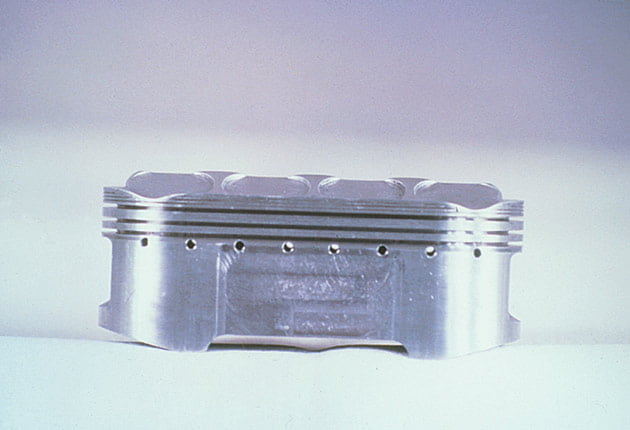
There remain some doubts about the efficiency of the intake, the machining of the pistons and segments, or the cooling of such an engine, so we decide to experiment with this new shape of piston on a single cylinder. . Initially, it is only equipped with two valves. As this seems to work, we gradually equip it with 4 then 8 valves while already noticing certain significant problems: In fact, the engine explodes if we exceed 10 rpm!
The valves are not the cause and neither are the pistons. There is mainly a problem of deformation of the two connecting rods which equip the piston and which allow the piston pin to escape.
Thanks to the occasional help provided by the Honda Engineering department, others are being redesigned and machining precision is being increased.
Segments are also a big concern. Their machining is both extremely complicated and approximate. We even go so far as to test segments in two parts that can be “clipped” into one.
After many ideas and tests (pistons with 1, 2, 3 or 4 segments), and in the absence of numerically controlled machines, we therefore machine “by hand”, and tirelessly, hundreds of segments for n 'select only the best.
The work of machinists is a real headache since they must empirically take into account the deformation of fragile parts during machining so that their pressure is constant over their entire circumference once inserted into the cylinder.
In fact, in hindsight, it can be argued that this was the main feasibility problem with the engine.
Moreover, their imperfect machining will always cause problems in racing: The motorcycles will smoke a lot and will always have starting problems!
Once this pitfall has been overcome and validated on the single-cylinder, we move on to the next step.
The project has now been underway for six months and the small team moves in the middle of winter to Nasu Heights and begins studying the transition to four cylinders in a small hotel without heating.
Wrapped in blankets, the engineers finally decided to design an engine with a 100° V called “0X”.
![[Oldies] Honda NR 500 1979 Honda211](https://i.servimg.com/u/f25/13/15/94/65/honda211.jpg)
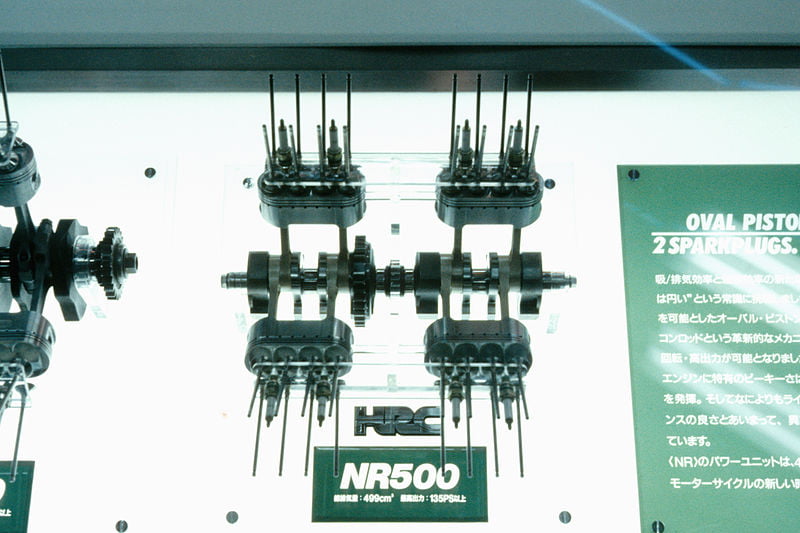
A few months later, in April 1979, the engine began its bench tests. Honda NR 500
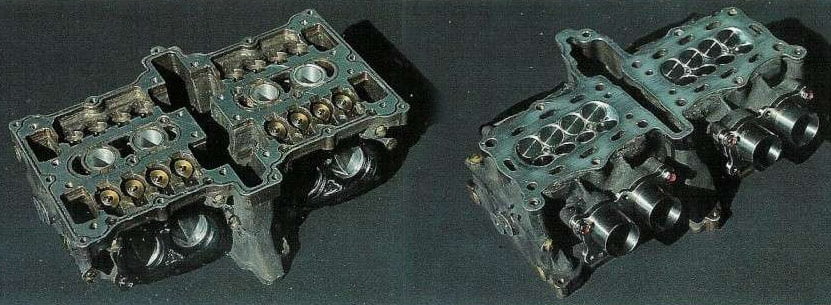
The gearbox still gets stuck, the valves often break, and above all, the engine still only develops 110 horsepower, but the season has started and the management is starting to get impatient...
We then decided to enter the motorcycles in the race, even if it meant continuing their development in real conditions.
Aware of the problems still unresolved, the team of Yoshimura and Irimajiri does not expect to work miracles and limits the racing version to 100 horsepower at 16 rpm.
![[Oldies] Honda NR 500 1979 Pho_0110](https://i.servimg.com/u/f25/13/15/94/65/pho_0110.jpg)
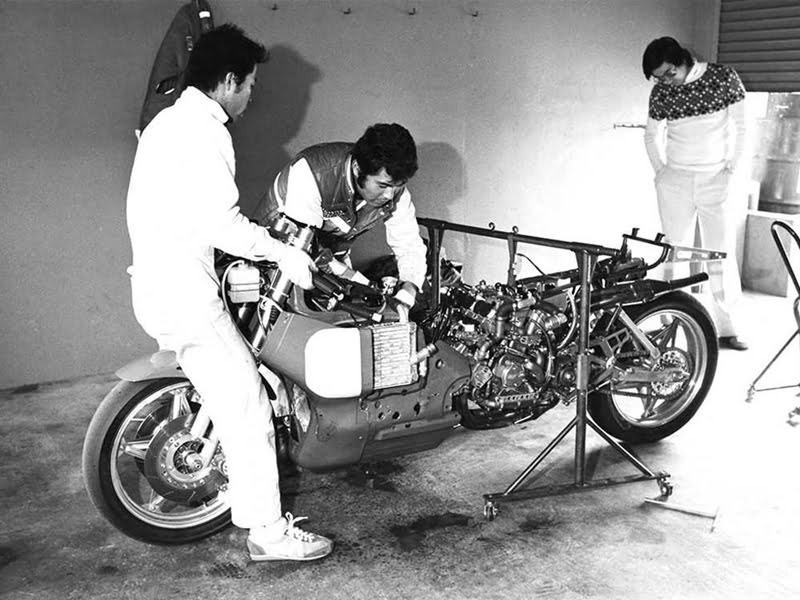
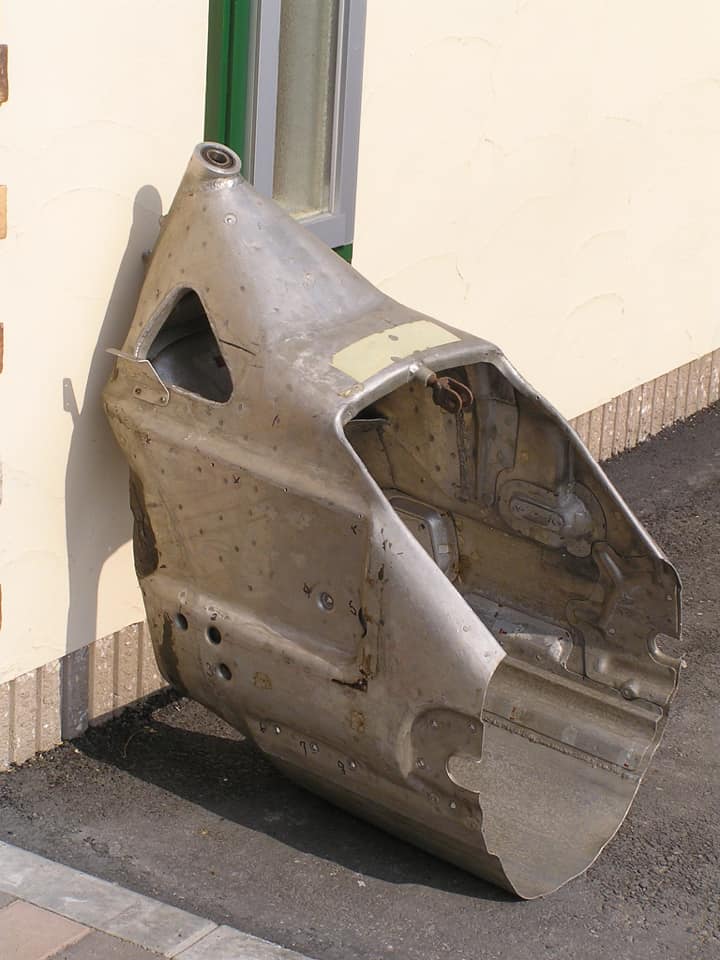
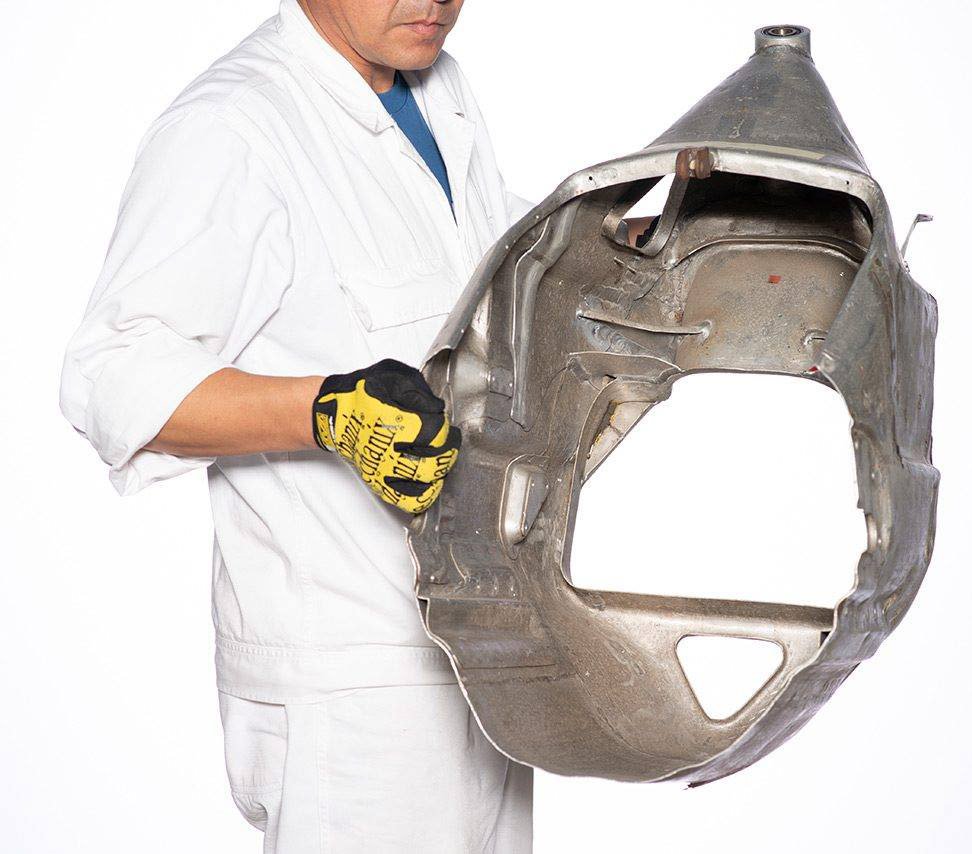
In parallel, Tadashi Kamiya had an equally extraordinary chassis built: with its semi-monocoque aluminum fairing, its 3 radiators including 2 side ones, its slotted discs, its stamped rims, its F1-style wind screen and its inverted fork with separation of springs and shock absorbers, the cycle part is exceptionally innovative!
![[Oldies] Honda NR 500 1979 Nr500110](https://i.servimg.com/u/f25/13/15/94/65/nr500110.jpg)
![[Oldies] Honda NR 500 1979 Nr500210](https://i.servimg.com/u/f25/13/15/94/65/nr500210.jpg)
This shell is nicknamed “shrimp shell” by the Japanese themselves and is made of a 1mm aluminum sheet weighing 5 kilos in total.
The motor fits in from the rear and is secured by 18 6mm bolts on each side.

Although it has not yet been definitively validated, the wheels are only 16 inches, allowing a weight gain of 4 kilos and a lowering of 5 cm compared to the usual 18 inch wheels.
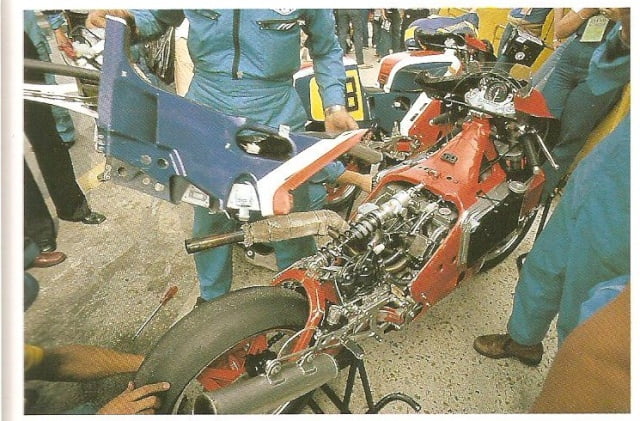
We finished assembling two machines as best we could and, on June 13, they took part in tests for three days on the Suzuka circuit where, despite the problems, the drivers Takazumi Katayama et Mick Grant, as well as the journalists, are rave, the Japanese even going so far as to announce a little prematurely: » I will be World Champion in 1980! “
![[Oldies] Honda NR 500 1979 Hdgp410](https://i.servimg.com/u/f25/13/15/94/65/hdgp410.gif)
![[Oldies] Honda NR 500 1979 Hdgp510](https://i.servimg.com/u/f25/13/15/94/65/hdgp510.gif)
However, the tests were quite unsatisfactory: few laps completed, very slow times, engine running hot, deficient suspensions, hesitation about the brand and size of the tires (Dunlop or Michelin, 18 or 16 inches).
We announce a time of 4 seconds faster than that of a Suzuki 500 RG driven by a Honda pilot. The future will show that the latter should not really give his all for fear of displeasing his employers...
The motorcycles were immediately shipped to Europe where they were transported to Silverstone for the 11th Grand Prix of the season, on August 12, 1979.
![[Oldies] Honda NR 500 1979 Honda210](https://i.servimg.com/u/f25/13/15/94/65/honda210.jpg)
In fact, Honda's idea is to show the world that they are present this year, while trying to really develop the bikes during the season.
![[Oldies] Honda NR 500 1979 1979_s10](https://i.servimg.com/u/f25/13/15/94/65/1979_s10.jpg)
Unfortunately, equipped with 16-inch wheels, the Hondas hardly qualified in the last row and their performance in the race was very disappointing: Mick Grant falls at the first turn due to an oil leak on the rear tire and his motorcycle catches fire before the eyes of Soichiro Honda !
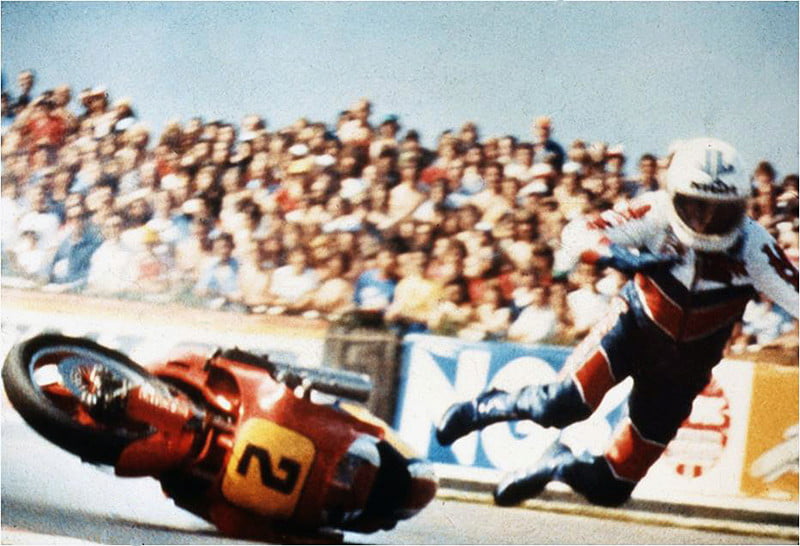
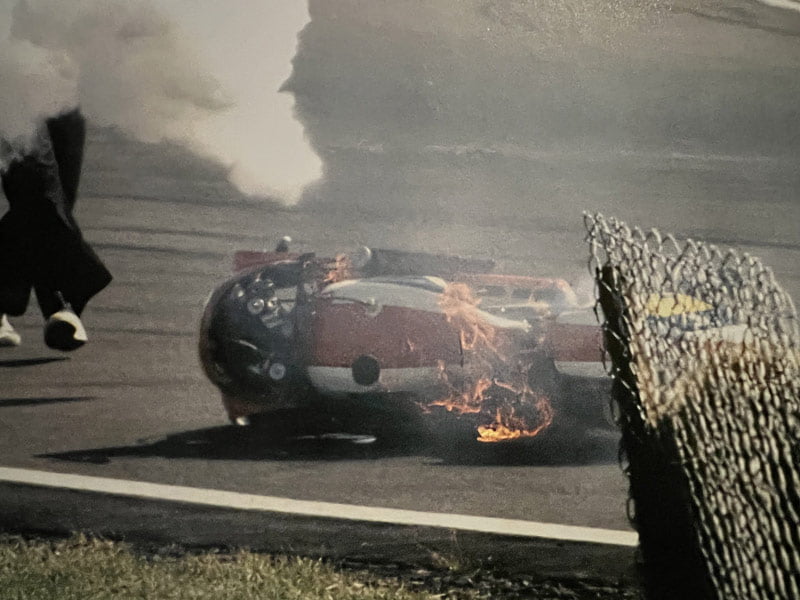
Takazumi Katayama didn't do much better and retired after four laps due to ignition problems...
![[Oldies] Honda NR 500 1979 1979_s11](https://i.servimg.com/u/f25/13/15/94/65/1979_s11.jpg)
It's a shock for Honda, which did not expect to experience such domination from competing motorcycles! Soichiro Honda and his Japanese bodyguards don't like it...
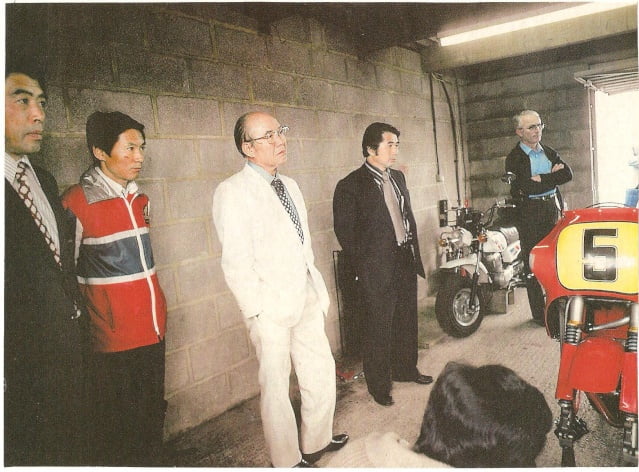
What will the Tokyo giant do in the face of this humiliating affront?
More tomorrow... Honda NR 500
Sources: Honda, Honda Motorcycle Racing Legend, Honda NR Oval Piston, etc.
Honda NO 500