















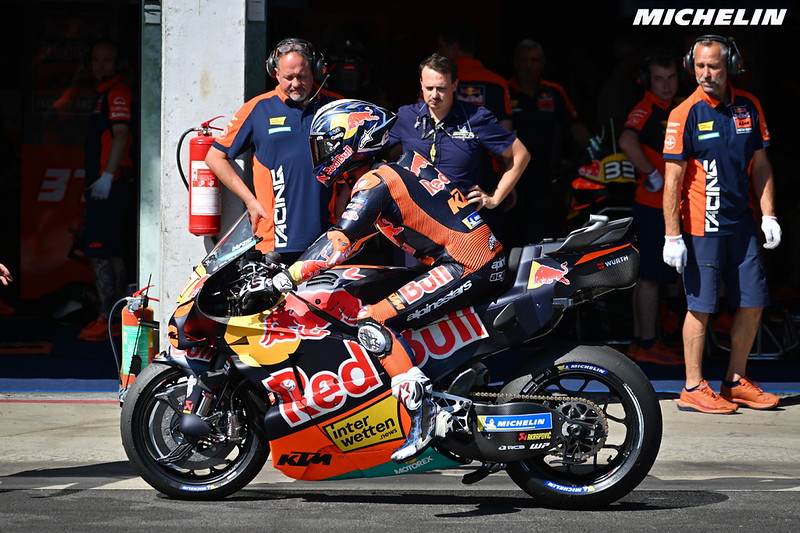
In Brno, several major incidents went largely unnoticed, despite their seriousness. We were all focused on Marco Bezzecchi's crash and Marquez's victory, but no one paid attention to the latest mechanical problem suffered by KTM. Not only is it unfortunate for Pedro Acosta, but it also jeopardizes the entire grid.
Enough is enough
Breakdowns are part of the game in motorsports. Sometimes, a championship can hinge on an engine failure; it can affect someone in the lead at the worst possible moment. It's the uncontrolled part of motorsports, and it's something I personally love.The gods of mechanics spare no one, not even the best-prepared teams equipped with the most advanced technologies.
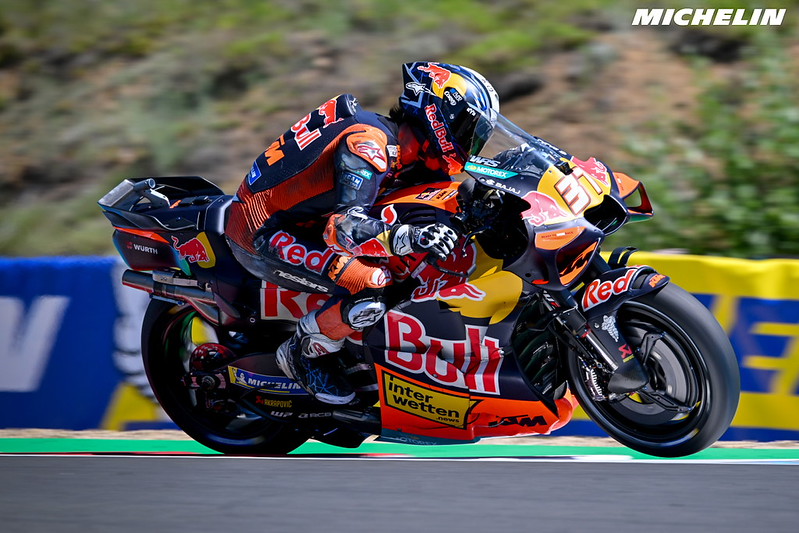
You can already see where I'm going with this? Photo: Michelin Motorsport
Seeing an engine failure or an electronic problem from time to time isn't shocking at all. I'd even say it adds depth to the storyline of a race. But in KTM's case, it's no longer fun.During the two most important days in the Czech Republic, Acosta suffered mechanical problems. Saturday is his Ride Height Virginwhich, stuck in the lowered position, prevented it from rolling properly. He fell while trying to readjust it. Then, on Sunday, something even worse happened: an engine failure ended all his hopes while he was running in the top 5.
For several years, the RC16 are plagued by significant reliability problemsThis had happened to Brad Binder in Austin, and then last year, broken chains caused havoc in the Austrian ranks. However, this season it's even more serious. First, it diminishes the incredible effort put in by Pedro Acosta since the start of the season. MotoGPThe Spaniard is riding at a very high level, far above that of his teammates – who are also very good riders – but is not being rewarded. Furthermore, and most importantly, The problem is that his KTM could become a major danger to others.
This episode is not going away; the problem needs to be addressed.
The Barcelona crash, still fresh in everyone's minds, has generated a lot of discussion. We've used it to reassure you about Alex Marquez's condition, but we mustn't forget that the Gresini rider's crash was caused by an engine failure on Acosta's KTM RC16. In Brno, fortunately, he was not followed by anyone.
These random problems could be very costly, and I get the impression that the authorities are waiting for a serious accident to happen before they react. Alex Marquez hit the back of the Austrian rider on a secondary straight in Barcelona; his speed was relatively low compared to other times of the year. But just imagine if a crash were to occur at Mugello, right on the straight, where our heroes easily exceed 360 km/h. I'm also thinking of Aragon, where the final corner, which follows a long straight, is quite fast. The tragedy is not so far away.
The risk inherent in these failures is enormous. First, for the KTM rider himself. The majority of serious accidents in the history of motorsports are not due to single-vehicle off-track excursions.A collision between two pilots, whether on the ground or from behind, is statistically more dangerous than a highside Since the introduction of run-off areas, the movement is less natural. While some drivers may stiffen before hitting the ground when falling alone, here, everything happens in a fraction of a second, with the back being the most vulnerable part of the body. Furthermore, this is highly likely to occur on a straightaway, as drivers follow each other. Thus, the driver who is hit falls directly in front of them, onto the track, where they may be at risk of a secondary collision. This has nothing to do, for example, with falling into a more or less secure gravel trap..
You might think I'm being overly alarmist, but I could cite at least ten serious accidents of this type in the history of motorsport. That's exactly what happened in Sepang in Moto3 last year, when José Antonio Rueda hit Noah Dettwiler from behind. Fortunately, both are still alive.
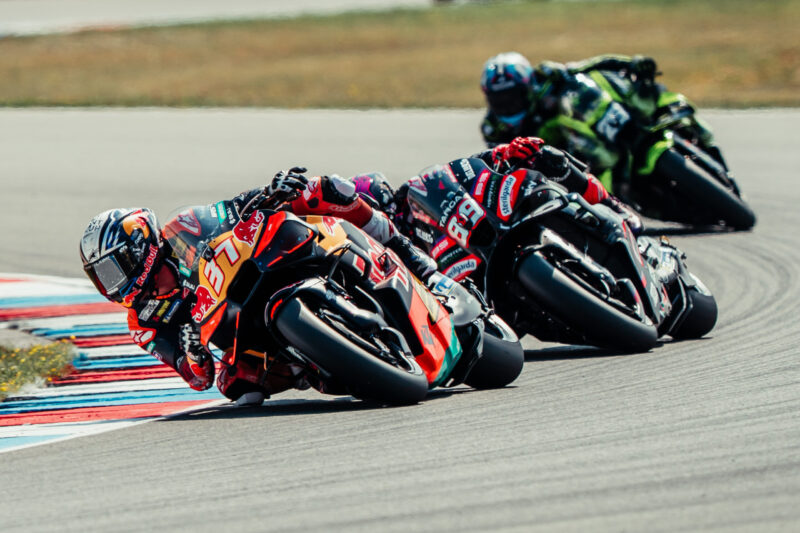
MotoGP has never been so close. Today, the gaps are smaller, which increases the risk of accidents and collisions in general. Photo: KTM
Secondly, it can be very dangerous for the rider who makes the impact. If they make a head-on collision, they too will fall forward, therefore at considerable speed, and onto the track at the mercy of others in the event of a pack race. If they try to swerve at the last moment, as Alex Marquez did in Barcelona, it can also cause a dramatic situation. The Gresini rider himself admitted that he was lucky the wall wasn't closer at that point; fortunately, indeed, that there was no other rider to his right at the moment he made the handlebar turn.
I didn't even mention the concern about Ride Height Virginwhich, when stuck in the lower position, can also pose a danger during braking and cornering. I think that makes sense..
Conclusion
In my opinion, these sudden engine cut-outs should be immediately addressed by the safety commission and the highest authorities. We can envision an investigation, penalties if it happens too frequently, or fines if nothing is done. Acosta himself was very critical of KTM after Sunday's raceAs if motorcycling wasn't dangerous enough, these problems increase the risk of serious accidents tenfold in an era where motorcycles, faster than ever, are veritable dragsters in a straight line.
Mechanical breakdowns are an integral part of sport; they are its very soul. But in this specific case (a repeated breakdown), which is rare to boot, KTM unintentionally exposes other riders to extremely accident-prone situations.
I'm curious to know what you think about these repeated breakdowns. Tell me in the comments!
As a reminder, this article only reflects the thoughts of its author, and not of the entire editorial team.
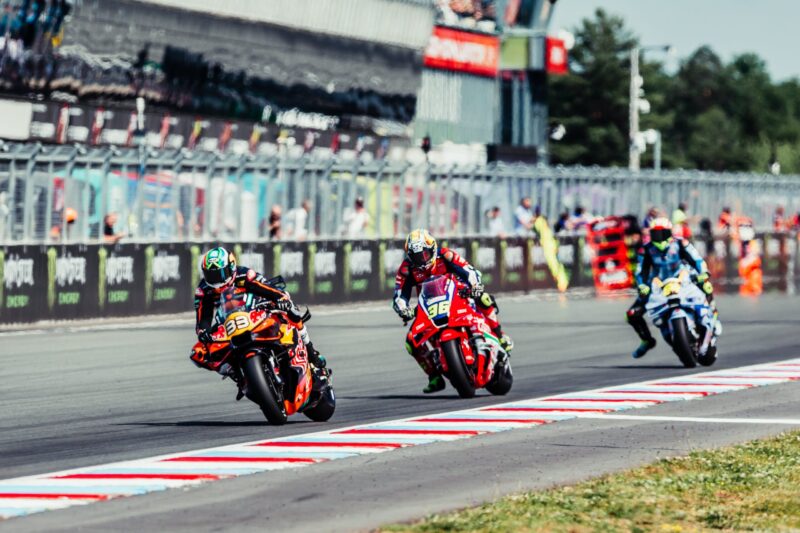
We're talking about Acosta, but there are three other KTMs on the track! Photo: Michelin Motorsport
Cover photo: Michelin Motorsport