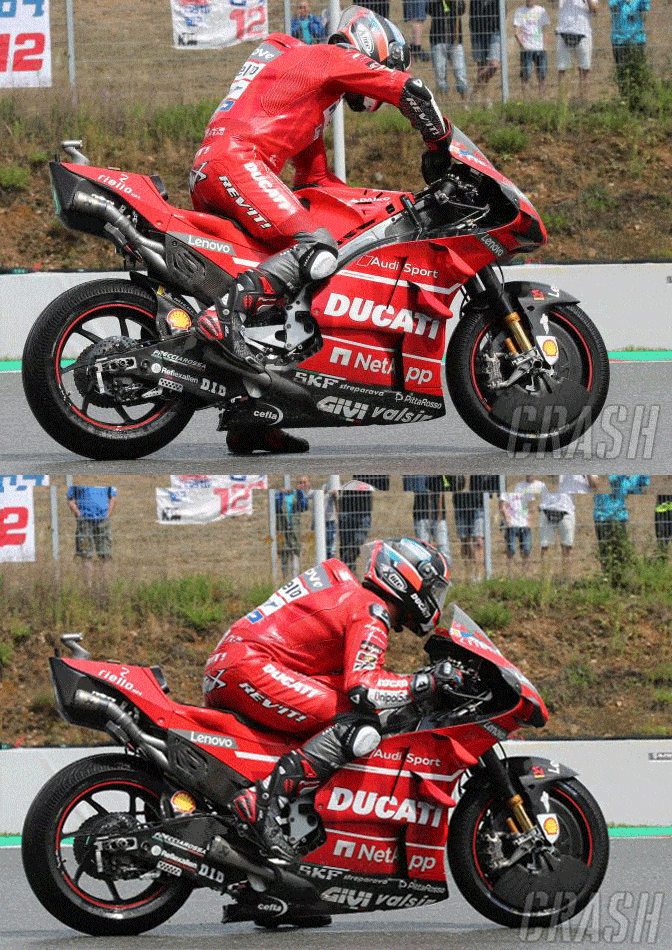









A Ducati rider turning a lever on the dashboard of his GP19 to lower the rear of the bike before the start of a MotoGP race is now a current show.
💥 @Petrux9 explodes off the mark with his practice start#QatarGP 🇶🇦 pic.twitter.com/lh6A8y3nTi
- MotoGP @ 🏁 (@MotoGP) March 9, 2019
The holeshot device was spotted during the Sepang test in January, but Jack Miller later revealed that he first used it in Motegi last October.
The system appears to have worked smoothly until Silverstone, where Jack Miller's front row on the starting grid was too close to the first corner to allow disengage the system during the first turn (see here).
Our excellent colleague Peter McLaren therefore asked Conrad Cecchinelli, Director of MotoGP Technology and also former Vice General Manager of Ducati Corse, to speak on the subject for the site crash.net.
We report here a partial translation into French, with the kindness of the author and our sincere thanks.
Crash.net: Corrado, can you explain why holeshot devices work?
Conrad Cecchinelli : “The main effect of the holeshot device is to lower the center of gravity. The ratio between the height of the center of gravity and the horizontal distance between the center of gravity and the center of the rear wheel is thus modified. Maximum acceleration depends on this ratio because, on a dry surface with the current tires, the acceleration limit at the start is the wheelie. Not skating. This is why you want to lower the center of gravity. »
Crash.net: Ducati lowers the rear suspension, Aprilia the front suspension. If you had a choice between front or rear, wouldn't it be harder to ride with lowering the front suspension?
Conrad Cecchinelli : “The top priority of a holeshot device is simply to lower the center of gravity, by whatever means possible. But there is also a side effect, which you describe. »
“In mathematical terms, if we call the height of the center of gravity “H” and the distance between the rear wheel and the CoG “B”, as we said, what matters most is the ratio B/H. »
“The small effect of lowering the front is that you also do two other things: First, you pivot around the rear wheel, which changes the balance of the bike by putting more weight on the front wheel, since the CdG moves forward a little, going downhill. »
“Second, because the fork is not vertical, by lowering the fork you also move the front wheel rearward, increasing the front static weight. This is partly offset by the mass of the front wheel moving rearward, increasing the chance of a wheelie, but the former wins. »
“Both of these side effects are helpful for having less wheelies, but they are a much smaller order of magnitude than lowering the center of gravity. »
“For this reason, the choice of whether to install the holeshot device front or rear depends on more practical reasons, such as the method used to compress and lock the suspension, and how well you can compress the suspension. »
For example, you may only be able to compress 50% of the front suspension travel, but 60% of the rear suspension travel. If the change in center of gravity were greater at the rear, it would outweigh the secondary benefits of using the front suspension. »
"It's also easier and safer to place the unit on the back because you have more options for working with the suspension, instead of using 'hooks' to hold the front down like you see it in motocross. And it's harder to review the device if you want to keep it secret from your rivals. »
Crash.net: There is a switch on the Ducati's dashboard to operate the device before departure. Without electronics, how could it compress and lock the rear suspension in place?
Conrad Cecchinelli : “For example, there could be some sort of lobe that is interfering with the rear suspension linkage. So you pull the lobe up and it compresses the rear suspension. But it depends on the suspension design. »
Crash.net: In your opinion, what difference in performance could a holeshot device make?
Conrad Cecchinelli : “It can make a difference, that’s for sure. Let's imagine, to facilitate the calculations, that the ratio of the horizontal distance between the center of gravity and the contact surface of the rear wheel (B), and the height of the CdG (H) for a MotoGP motorcycle is 1.
“So, for example, the CdG is 0,7 m from the ground and 0,7 m in front of the contact patch of the rear wheels. »
“Your geometric maximum acceleration is when the weight on the front wheel is reduced to zero. So forget about the front wheel and just think about the point where the rear wheel is in contact with the ground. »
"It is now the pivot point of a downward moment created by the (vertical) weight of the motorcycle across the CoG which, at the wheelie point, is canceled by an equal upward moment, caused by the force of (horizontal) acceleration through the CoG. »
“The maximum acceleration possible to reach the starting point of the wheelie (geometric acceleration limit) comes down to the two measurements mentioned: The horizontal distance between the rear wheel and the center of gravity (B), divided by the height of the center of gravity (H).
“So in our example it would be 0,7m/0,7m = 1(g) of maximum acceleration before a wheelie. »
"Assuming that a holeshot device at the rear can compress the suspension by 70mm, the CdG will be lowered by 35mm in turn (assuming the horizontal position of the CdG is halfway between the front and rear). »
“The maximum geometric acceleration then becomes 0,7m/0,665m = 1,05g. »
“But you can probably only use this extra maximum acceleration for a short distance. So, a holeshot device can offer a big advantage, for a short time. »
“It can help you be the first driver in your starting line at the first corner, for example. »
Find the full article in English on Crash.net
To visualize as best as possible the amplitude of the lowering of the rear of the Ducati (and therefore twice that of the CdG), we used the documents from the site crash.net and superimposed them…