








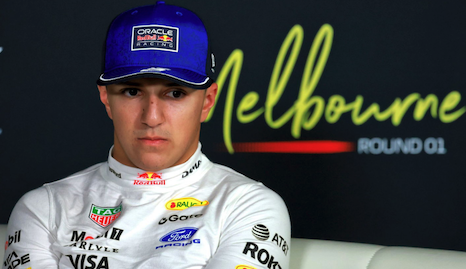
The weekend had started in the best possible way for Isack Hadjar. Impressive in qualifying with a third place on the grid, the young Red Bull Racing driver hoped to be a frontrunner in the Grand Prix held at the Albert Park Circuit in Melbourne.

A mistake that could have been avoided, according to Hadjar.
But the Franco-Algerian's race came to an abrupt end after only twelve laps, the victim of an engine problem on his single-seater equipped with the new RBPT-Ford power unit.
A promising start… quickly compromised
Hadjar He had, however, made a particularly strong start when the lights went out. The Red Bull driver even believes he could have taken the lead from the first few corners against the eventual winner. George Russell.
"The start was very good. I felt like I could easily take the lead at turn 3."
But the situation deteriorated rapidly. From the very first rounds, Hadjar noticed a worrying behavior from the engine.
"The engine was making a really strange noise. I quickly realized I probably wasn't going to finish the race."
Faced with this loss of performance, the driver had no chance of competing against faster cars on the straights.
"It's difficult to fight when someone is driving 30 km/h faster than you." »
Another frustrating element for the young pilot: the state of the battery at the time of departure. Hadjar revealed that he had started the race with no energy reserves available, a situation which was not related to a technical failure but rather to a procedural error.
For him, this is an issue the team will need to address quickly. It wasn't a technical problem. It's simply something we need to manage better so that it doesn't happen again.
2026 engines still difficult to master
Beyond this incident, Hadjar believes that the new power units introduced in 2026 still pose many challenges for the teams.
Racing conditions – temperatures, acceleration phases and energy management – make engine calibration particularly complex.
"These new engines are still very new and the race scenarios are different from what we experienced during testing."
Teams are therefore continuing to learn how to exploit these new technologies, which react differently between practice, qualifying and the race.
Potential despite the disappointment
Despite this early abandonment, Hadjar He prefers to focus on the positive aspects of his Australian weekend. His qualifying performance and the pace he showed at the start of the race suggest that the car has real potential.
The young driver believes, however, that Red Bull will need to make rapid progress in managing these new power units to prevent this type of problem from recurring.
« Overall, the weekend was positive. But it's clear we need to do better.
After this frustrating introduction, Hadjar now hopes that the lessons learned in Melbourne will allow the team to take a step forward in the next round of the season.
