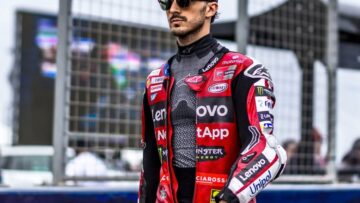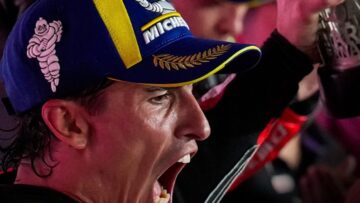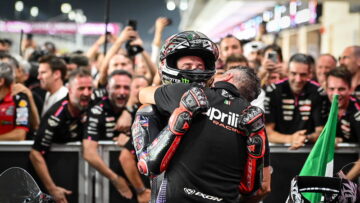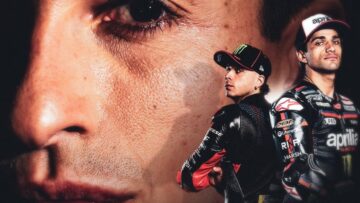





Jorge Martin had spoken of a "marathon." Halfway through the 2026 season, the term seems almost an understatement. Nine riders have already had to undergo surgery, for a total of twelve operations, while Johann Zarco treats a serious knee injury without having undergone surgery. Taken separately, each of these cases has its explanation. Put together, they raise a much more disturbing question: is modern MotoGP reaching the physical limits of those who make it happen?
It would obviously be too simplistic to blame all the problems on the 22 Grands Prix and 44 races. Fermin Aldeguer fractured his femur in training even before the season began. Maverick Viñales is still dealing with the consequences of an old injury. Pedro Acosta and Francesco Bagnaia underwent surgery for conditions related to repetitive strain rather than a specific crash… But it's the sheer number of these incidents that's striking. Aldeguer, Quartararo, Marc and Alex Marquez , Di Giannantonio, Acosta, Bagnaia, Bezzecchi, Viñales : nine riders have had surgery with ten Grands Prix still to go. And behind this statistic, another reality of MotoGP is gradually emerging.
The pilot barely has time to get injured.
In the past, a crash was part of the job and recovery was part of the season. Today, every absence potentially costs two races in the same weekend. And the championship sometimes restarts a few days later.
Marc Marquez is probably the most striking example. His right shoulder, already injured in Indonesia in 2025 , required two surgeries in the spring after a screw shifted and compressed a nerve. A broken foot at Le Mans then compounded the problem. He came back. He's winning. He's still in contention for the championship. But Silverstone served as a stark reminder of a reality his results might have obscured: his body still hasn't returned to its normal form.
Marco Bezzecchi suffered a broken collarbone and a serious knee injury. Alex Marquez had to undergo surgery after his accident in Catalonia. By Giannantonio also . Johann ZarcoHe, however, avoided surgery after multiple ligament injuries to his knee, but his return remains uncertain. The championship continues nonetheless.
The injuries of Bagnaia and Acosta tell a different story.
Accidents are inherent to motorcycle racing. They existed long before sprint races and 22- race calendars . The cases of Pedro Acosta and Francesco Bagnaia are therefore perhaps even more interesting.
Acosta underwent carpal tunnel surgery in June. Bagnaia took advantage of the summer break to have a double procedure for carpal tunnel syndrome and compartment syndrome.
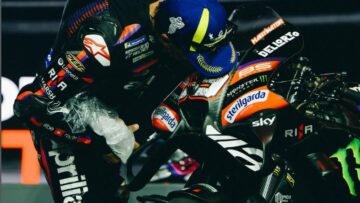
Here, it's no longer just about the consequences of a fall. It's about the body confronted with the repeated stresses of piloting.
Braking well over 1 g, violent accelerations, changes of direction, aerodynamics generating more downforce, technical devices allowing ever greater exploitation of performance: modern MotoGP bikes demand a lot from the rider.
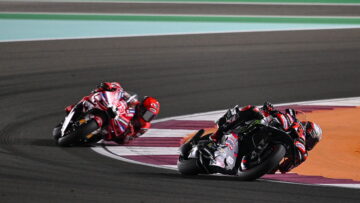
And now, this request is repeated twice during the race each weekend. The Sprint hasn't simply added an attraction to the Saturday program. It has practically doubled the number of race starts in a season.

44 MotoGP races, but the problem doesn't end on Sunday evenings
A testimony from Cal Crutchlow adds another dimension to the subject. The former driver mentions the 290 days a year he spent away from home when he was involved in that world. " Now, I couldn't and I wouldn't want to do it anymore ."
Because a MotoGP rider obviously doesn't only work during the 44 races. He travels, trains, participates in tests, analyzes data, fulfills his media obligations, meets with sponsors and takes part in the promotional operations imposed by a championship that has become a global entertainment business.
And this last dimension is likely to become even more important with MotoGP's current commercial strategy. Crutchlow draws a worrying conclusion: " MotoGP riders are being pushed to their limits ." He then goes further: " The careers of many of these riders will be shorter ."
The Liberty Media paradox for MotoGP
The issue goes beyond a simple medical report. MotoGP wants to grow. More events, more content, more rider exposure, spectacular season launches, commercial operations, and a product capable of working all year round: this logic is perfectly understandable.
But unlike many other sports, MotoGP's main asset is physically exposed every time its use is increased. A tired rider doesn't just become less efficient.
At 350 km/h, fatigue can also impair concentration and reaction time. And when a rider gets injured, the spectacle loses precisely what it was trying to build its audience around. That's the paradox. The more MotoGP tries to exploit its stars, the more it risks wearing them out.
Twelve operations, however, are not enough to scientifically demonstrate that the schedule has become excessive. It would be necessary to compare the seasons, the nature of the injuries, the actual mileage covered, accidents, and wear-and-tear pathologies.
Some of the injuries reported in 2026 clearly stem from specific circumstances. But the signal deserves to be taken seriously. Because it echoes the accounts of current and former riders, but also because the overall trend in the championship continues in the same direction: more races, more travel, more obligations, and increasingly demanding motorcycles.
The question, therefore, is perhaps no longer whether the drivers can finish a season like this. They can. They do. The real question is the one raised by Crutchlow : how many years can they do it at this pace?
In its quest to create a more exciting spectacle , MotoGP must be careful not to turn its champions into disposable commodities. Because in the middle of a 44- race season, one statistic is already starting to matter almost as much as championship points: staying healthy long enough to make it to the final round in Valencia.